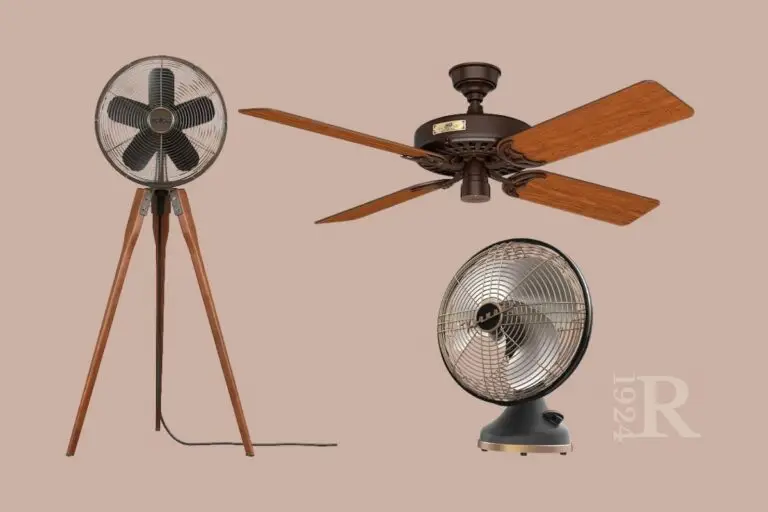

This post is for you if…
- You’re looking for a ceiling fans that will disappear seamlessly into the architecture, or one bold enough to make a statement on its own
- You have a pre-1940 house with plaster ceilings, exposed beams, or original details and every fan you’ve looked at looks wrong
- You’re shopping for a bathroom or enclosed porch ceiling fan and need damp-rated options that work in your Old House
The Shortlist — Every Pick at a Glance
Some links may be affiliate links, meaning I may earn a small commission if you choose to purchase — at no additional cost to you. I only share products I genuinely like, would use in my own home, or have researched and feel confident recommending.
Related: Choosing an Old House Ceiling Fan for Your Classic Home
The Problem With Ceiling Fans in Old Houses
Ceiling fans are polarizing.
I get it. We spend our money, time, and creativity bringing these houses to life and then we … well, we need to get the air moving. So we’re faced with either buying a fan that steals a little bit of our design soul, or finding options that even fan-haters can’t hate.
Walk into any big-box lighting aisle and you’ll find the usual suspects: fake wood blades, polished brass accents, a “transitional” motor housing that lack a design point of view. They’re appliances we put in the center of the room.
In an old house — plaster ceilings, original medallions, exposed timber, slate floors — those fans aren’t neutral.
The wrong fan is actively, depressingly wrong. Even when it’s required.
- A room with a painted medallion and 10-foot plaster wants either complete invisibility, a period-appropriate statement, or modern tension that makes sense.
- A room with exposed Douglas fir beams wants warmth or industry.
- A vaulted bathroom with dark stone floors deserves something architectural enough to hold its own against the material.
At Rosemont, we have a bronze Duplo Dinamico in the solarium. It’s a dual-motor oscillating fan with an old-world, steampunk-meets-industrial soul.
It’s a statement piece that earns its place WHILE effectively cooling a room that gets HOT.
That fan set the standard for how I think about ceiling fans in old houses: either the fan disappears completely, or it earns the attention it demands.
The Sculptural Statement: Matthews Fans
The Duplo Dinamico is the Rosemont solarium’s fan. If you want that same design language — industrial, architectural, mechanical — these three are the right territory.
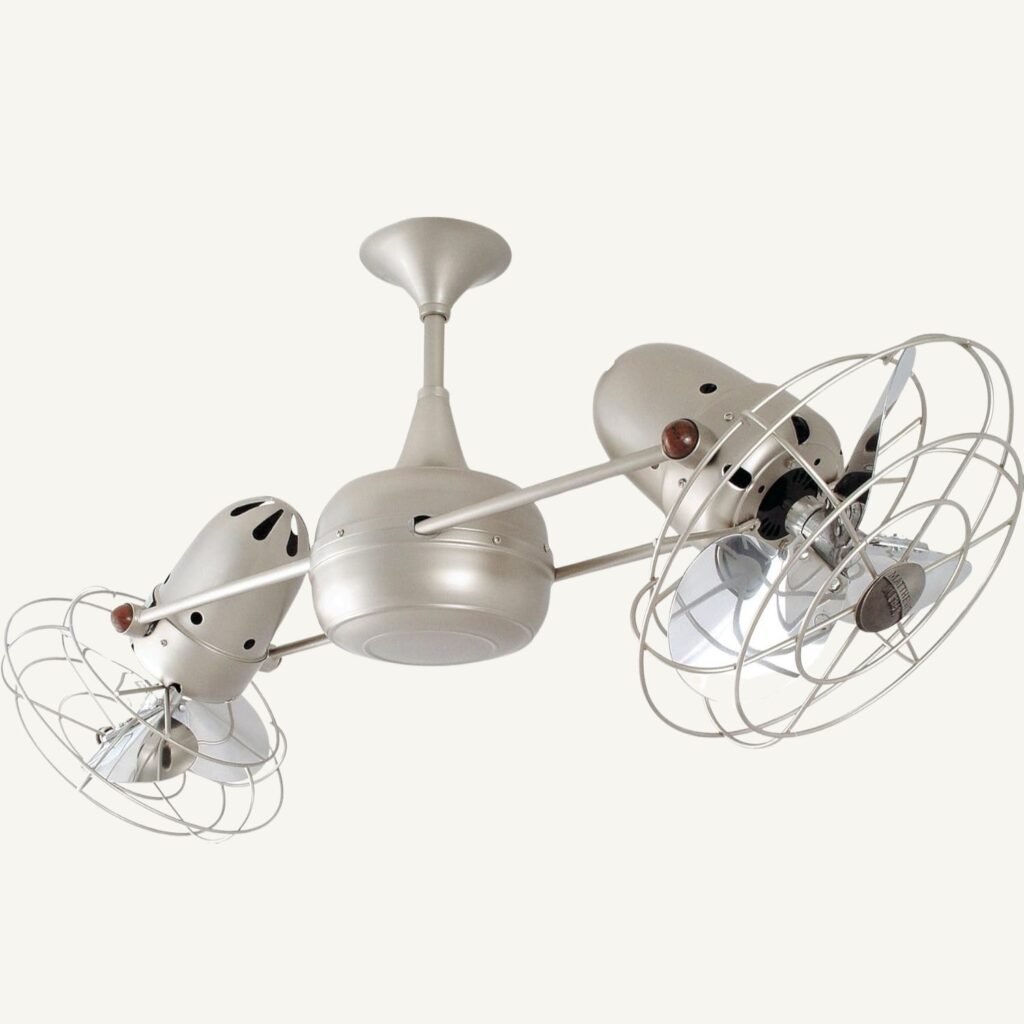
1. Matthews Duplo Dinamico Fan
What we use at Rosemont. Cast aluminum, dual oscillating motors, six brushed nickel blades, 39″ diameter, 3,201 CFM. The fan that set the standard for the solarium and every ceiling fan decision after it.
$$$
Damp rated: ✓ Indoor/outdoor damp
Smart: No — wall control
Reversible: ✓ via head positioning
Airflow: 3,201 CFM
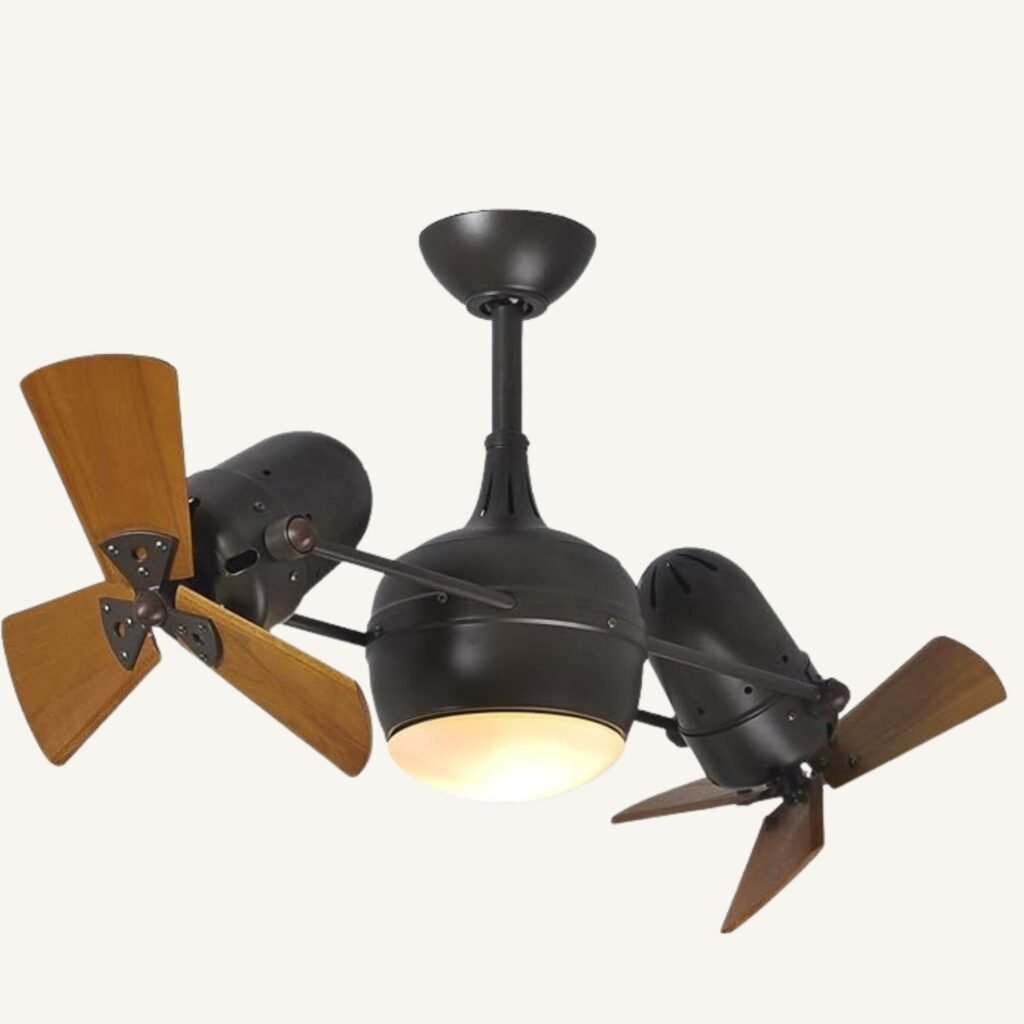
2. Matthews Fan Company Dagny (Dual Head)
Two independently adjustable heads on a central axis — the closest production fan I’ve found to the Duplo Dinamico’s dual-motor logic. Damp-rated. This one has a light kit available and is rated for higher airflow than the Dinamico.
$$$
Damp rated: ✓ Damp rated
Smart: No — handheld remote
Reversible: ✓ via head positioning
Airflow: 4,170 CFM
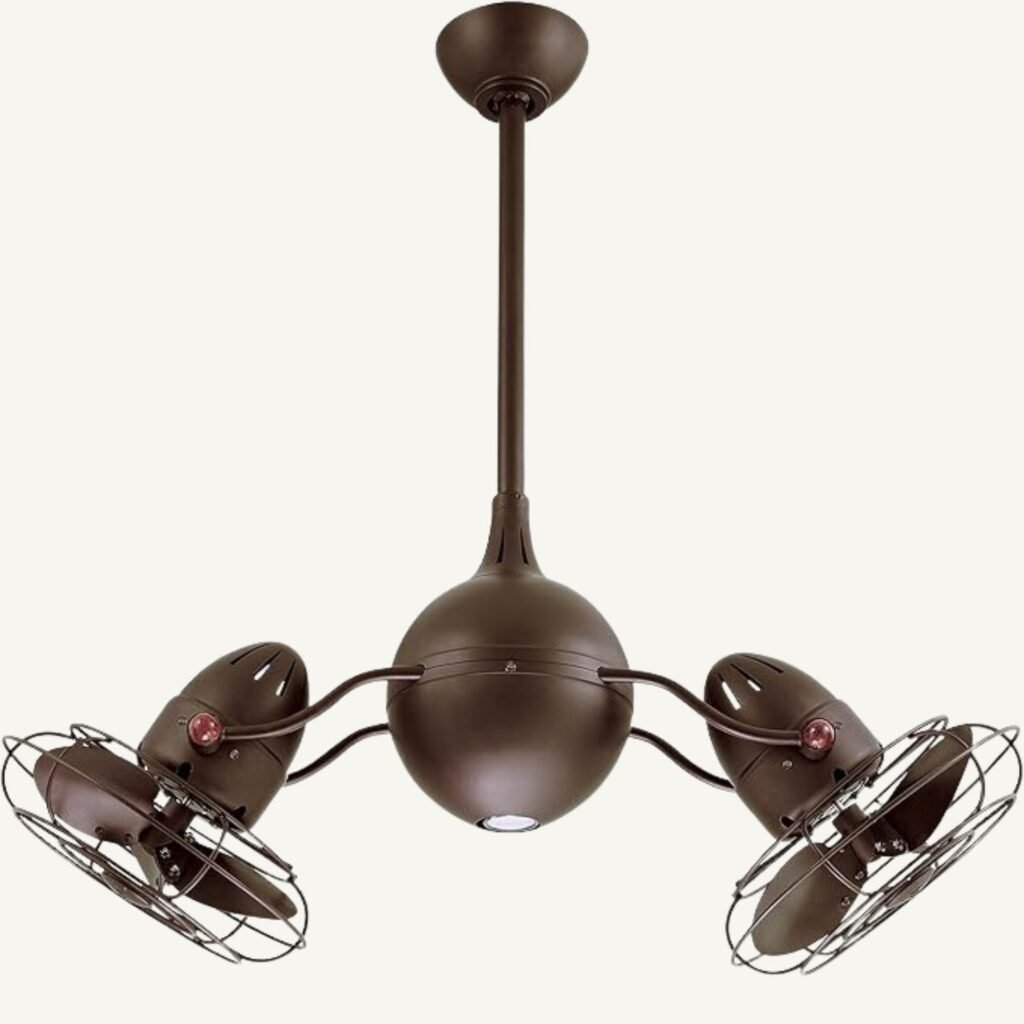
3. Matthews Acqua Indoor/Outdoor Damp Rated
Dual-headed, caged metal, 3000K, 94 CRI, damp-rated — the version of the Dinamico aesthetic that belongs in a vaulted bathroom or covered porch. A close cousin to the Duplo at a different format and scale.
$$$
Damp rated: ✓ Damp rated
Smart: No — handheld remote
Reversible: ✓
Airflow: 4,060 CFM
The Clean Modern: Ceiling Fans That Almost Disappear (But Aren’t Boring)
These fans don’t fight the room. They seamlessly work with it, so your design stays the center of attention, with a cool breeze.
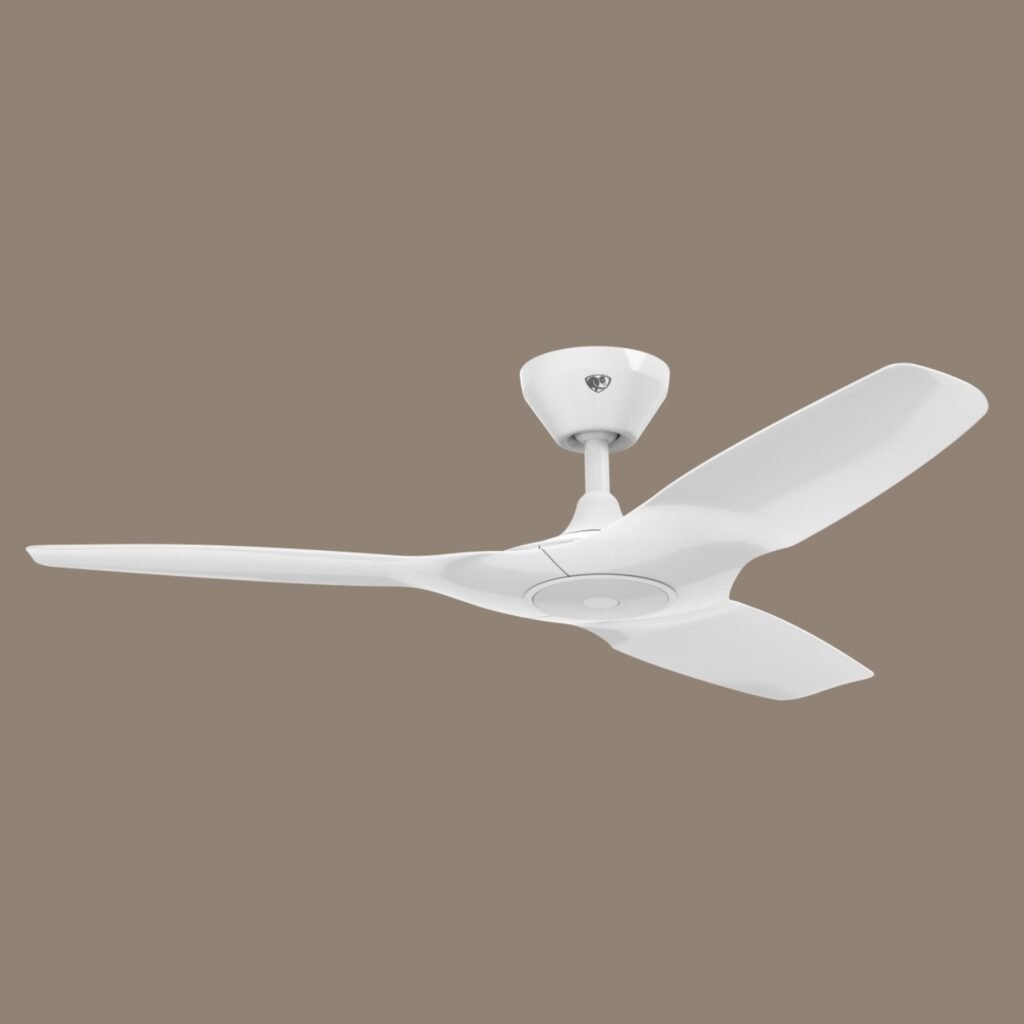
4. Big Ass Fans Haiku L Series (White)
Three aerodynamic wings, no visible hardware, completely silent. The fastest path to a fan that isn’t there. Note: the white blades have a sheen that makes this a better fit for spaces that need modern tension.
$$$
Damp rated: Depends on model
Smart: ✓ Wi-Fi, Alexa, Google Home
Reversible: ✓
Airflow: 4,662 CFM
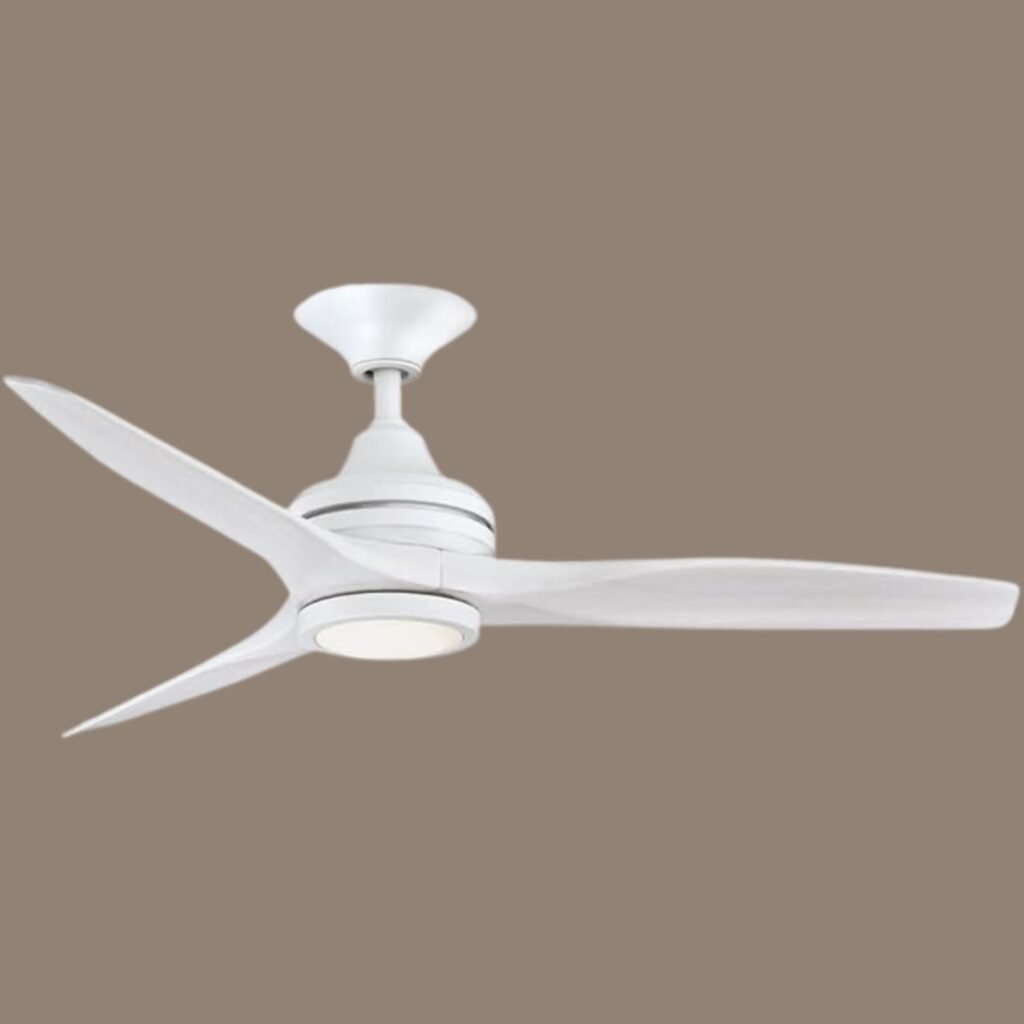
5. Fanimation Spitfire (White Motor / White Wood Blades)
Real carved wood blades in white, matte motor housing, light kit finish options. The carved blade detail reads as intentional rather than just decorative. Added bonus: there are SO many configurations on this one!
$$
Damp rated: ✓ Damp rated
Smart: ✓ Optional fanSync Wi-Fi
Reversible: ✓
Airflow: 5,164 CFM
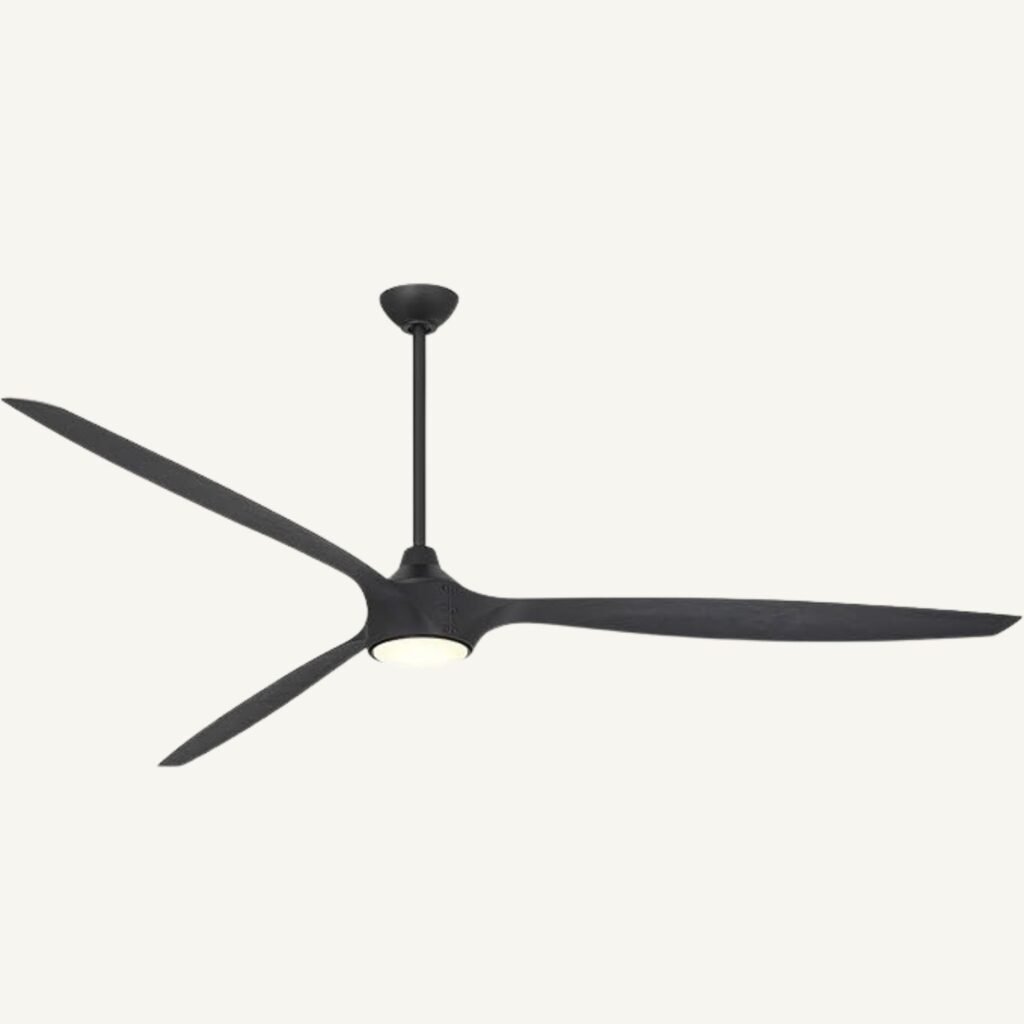
6. Minka-Aire Pierce 65″ — Coal / Shou Sugi Ban
This one’s a stunner. Coal motor housing, shou sugi ban-finish blades, etched glass lens. An architectural pick for a dark-academia study, converted attic, or any room where the ceiling fan should be part of the moody design.
$$
Damp rated: No — indoor only
Motor: DC
Smart: ✓ RF smart remote, 6-speed forward/reverse
Reversible: ✓
Airflow: 2,573 – 7,498 CFM
Light: Integrated dimmable LED
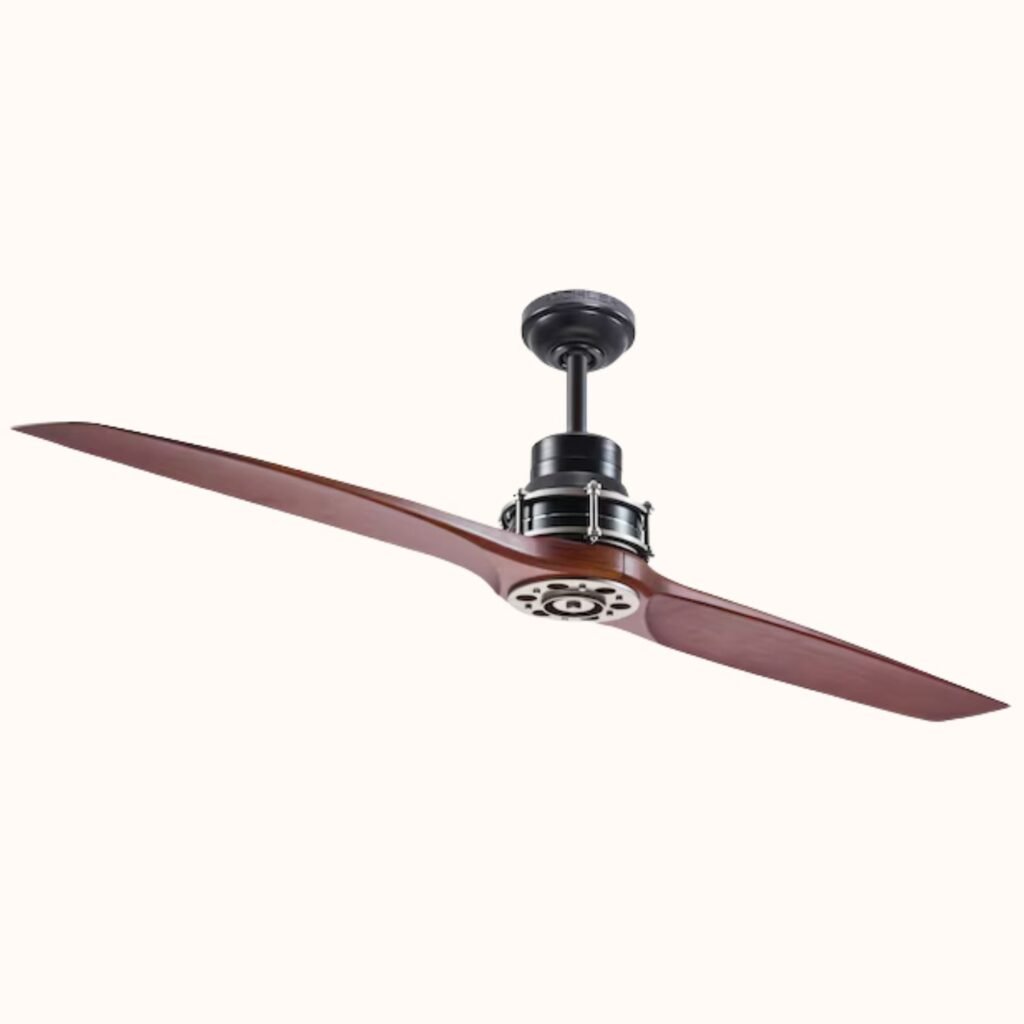
7. Kichler Lighting 2-blade with Antique Pewter Accents
For me, this looks like a fan you’d put in a bookish study. Or the reading room. Or a moody den. Or my office. Like the Minka-Aire, the blades aren’t wood, but wood-look, so rule this one out if that’s a deal-breaker for you.
$$
Damp rated: No — indoor only
Motor: AC
Smart: No — handheld remote
Reversible: ✓
Airflow: 5,289 CFM
Period Character: Ceiling Fans That Look Like They Belong
Old houses deserve fans with a point of view. These are fans with period-appropriate material and scale. Not costume. Period correct.
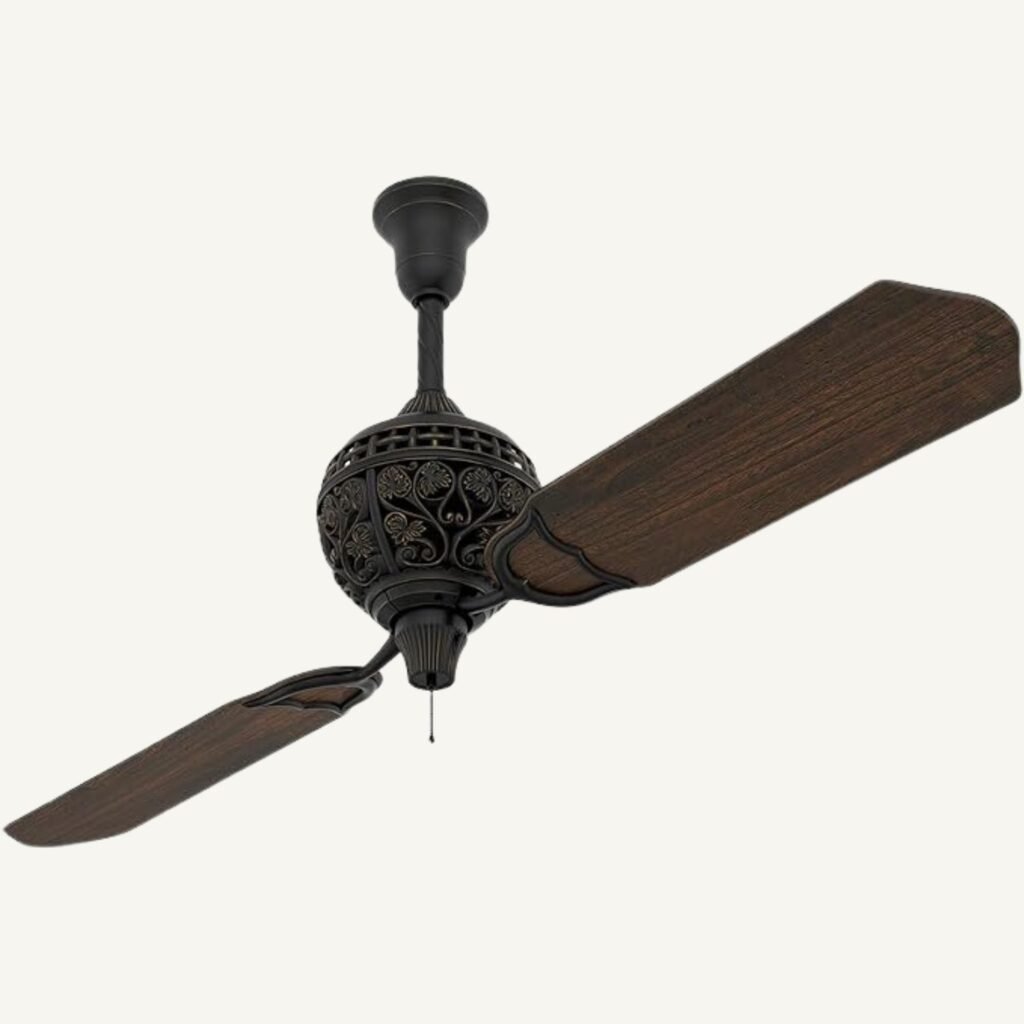
8. Hunter 1886 Limited Edition — 60″
Sand-cast aluminum motor housing, two solid wood blades, pull chain. A modern Victorian look that’s right at home in a high-ceiling bedroom without stealing the attention. Note: pull chain only — no remote available.
$$$
Damp rated: No — indoor only
Smart: No — pull chain only
Reversible: ✓
Airflow: 6,422 CFM
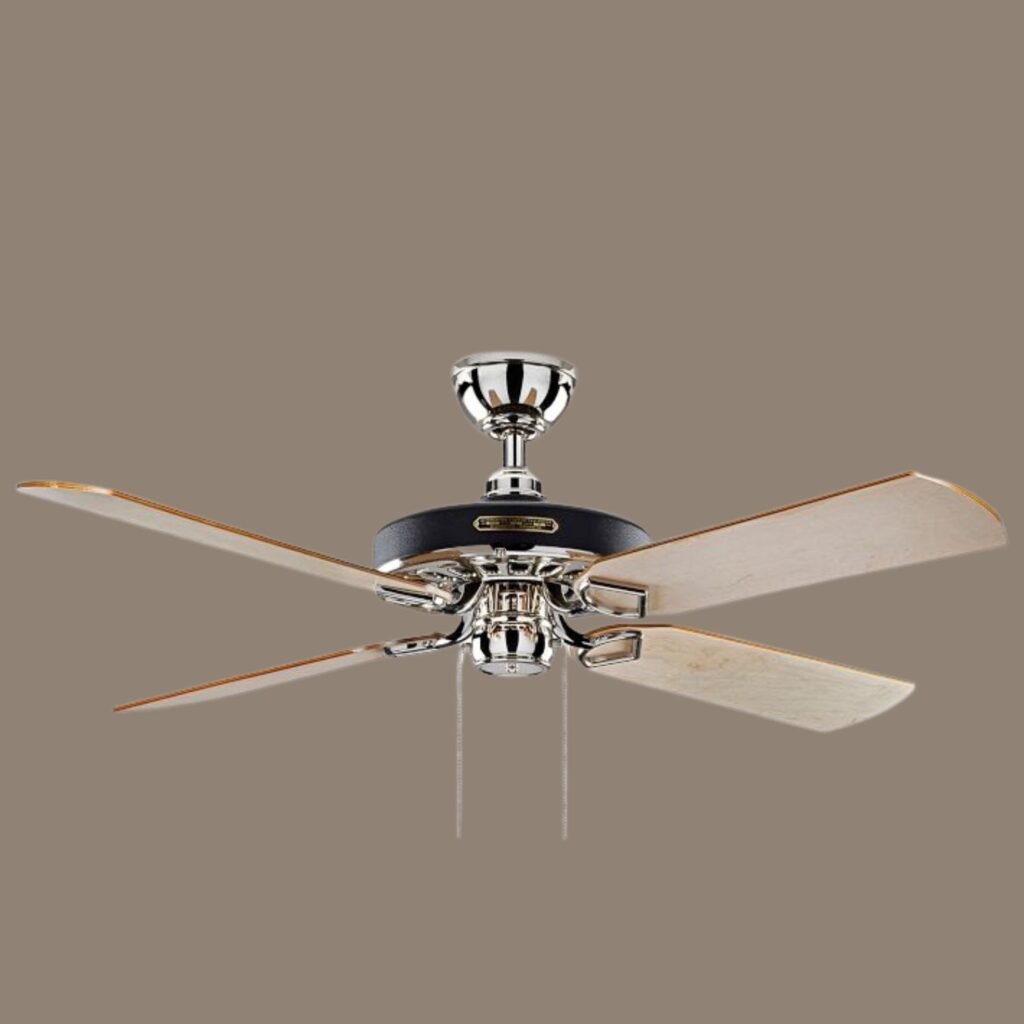
9. Rejuvenation Heron Ceiling Fan
Based on G.E. ceiling fans built between 1913 and 1925. Cast motor housing, precisely pitched four blades, ultra-quiet AC motor. The fan that looks like it was always there — because the design has been around for over a hundred years.
$$
Damp rated: ✓ Damp rated (covered outdoor)
Smart: No — pull chain + included remote
Reversible: ✓ Reversible AC motor
Airflow: 5,581 CFM
Want more vintage-look fan options? Choosing an Old House Ceiling Fan for Your Classic Home
The Windmill & Covered Porch Options
If your house calls for it — and you’ll know if it does — the windmill fan can be stunning. And for cooling down on the porch, there’s no need to be boring. An outdoor or covered porch space call for damp-rated fans that moves serious air. Scale up.
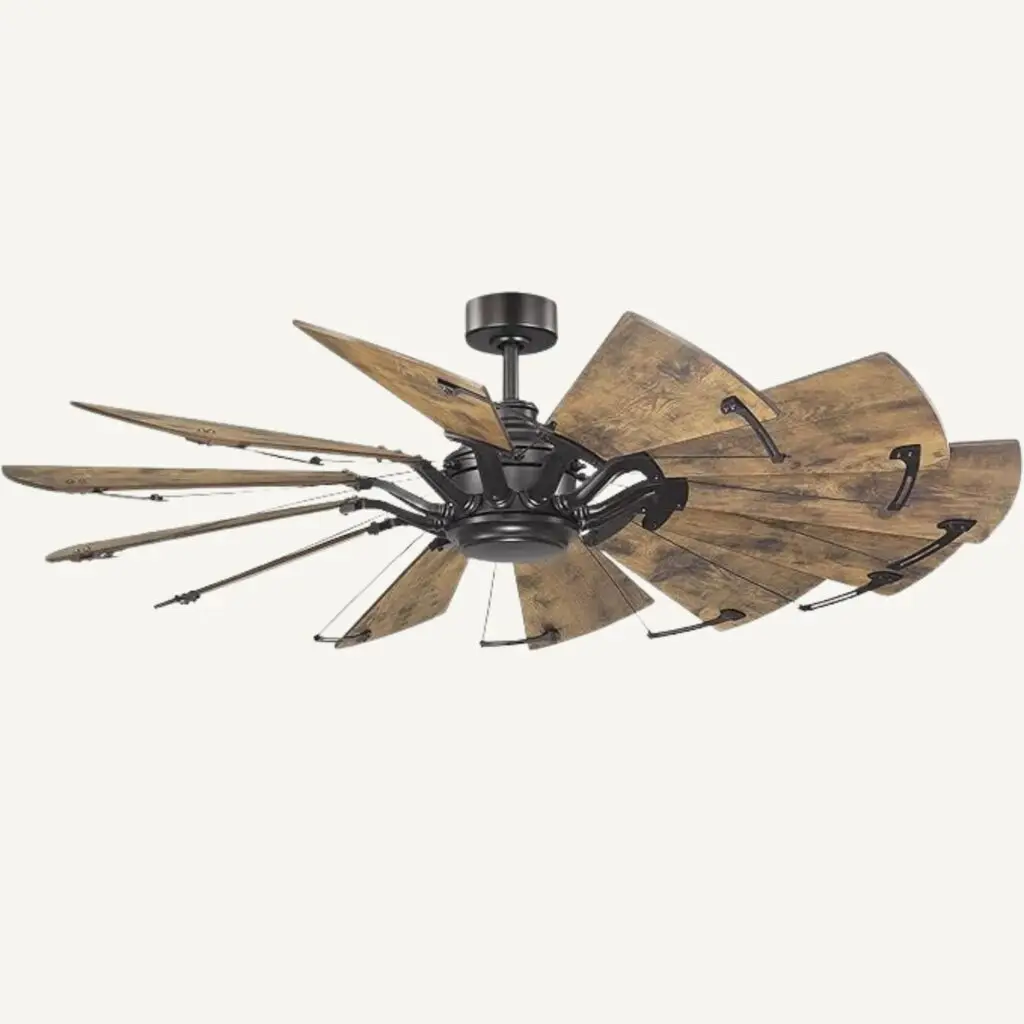
10. Progress Lighting Springer Collection Windmill Fan
Twelve distressed walnut blades in a windmill formation, architectural bronze accents, remote included, 60″. The farmhouse fan that doesn’t apologize for its country roots.
$$$
Damp rated: No — indoor only
Smart: No — 6-speed remote
Reversible: ✓
Airflow: 6,377 CFM
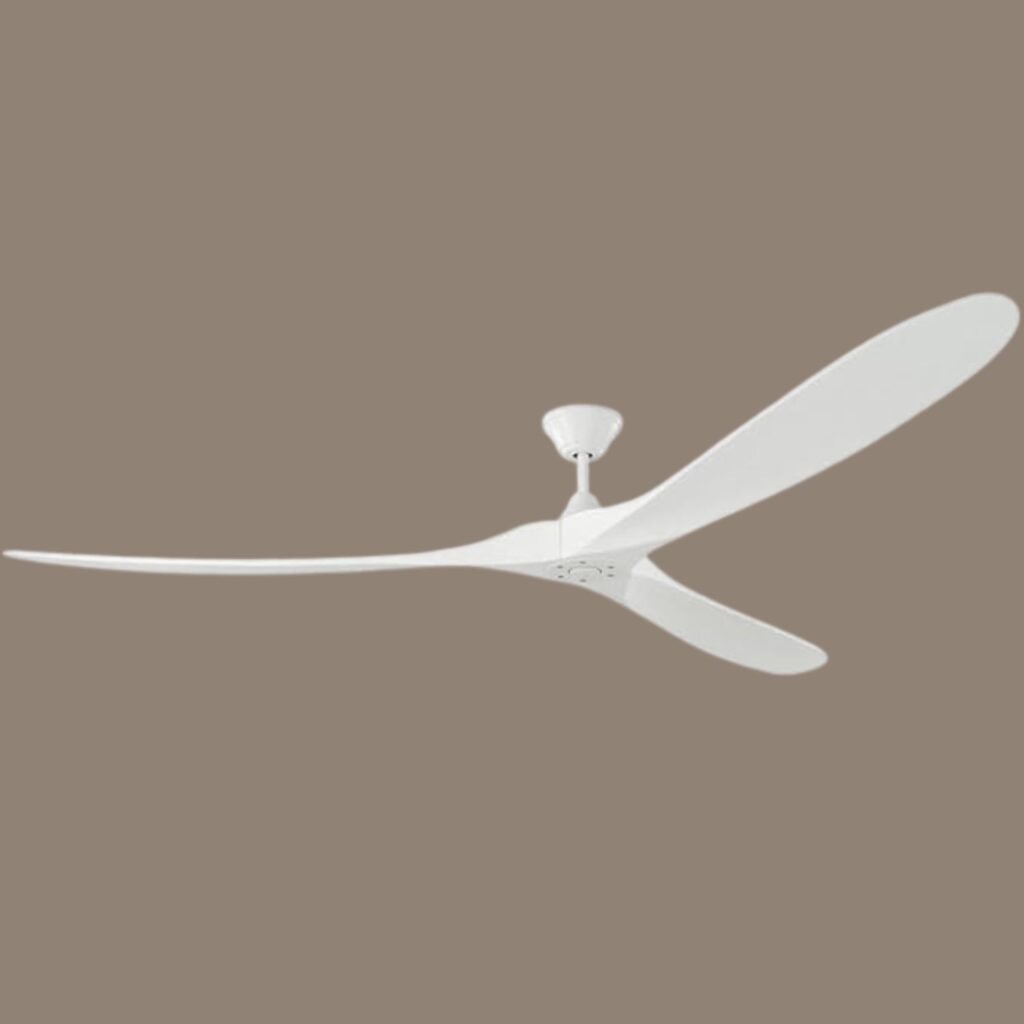
11. Monte Carlo Maverick Super Max 88″ Outdoor Ceiling Fan
Eighty-eight inches, matte white, Energy Star, damp-rated, 14,784 CFM. The covered porch fan that moves serious air without looking like it came from a barn supply catalog.
$$$
Damp rated: ✓ Damp rated
Smart: No — handheld remote
Reversible: ✓
Airflow: 14,784 CFM
The Fandelier: When the Room Wants a Chandelier and Airflow
Two options here — one is high-end room jewelry, the other is a look-for-less option. Both have retractable blades. No matter how you might feel about fandeliers, sometimes it’s the “rightest” option when nothing else will really work and you need that airflow.
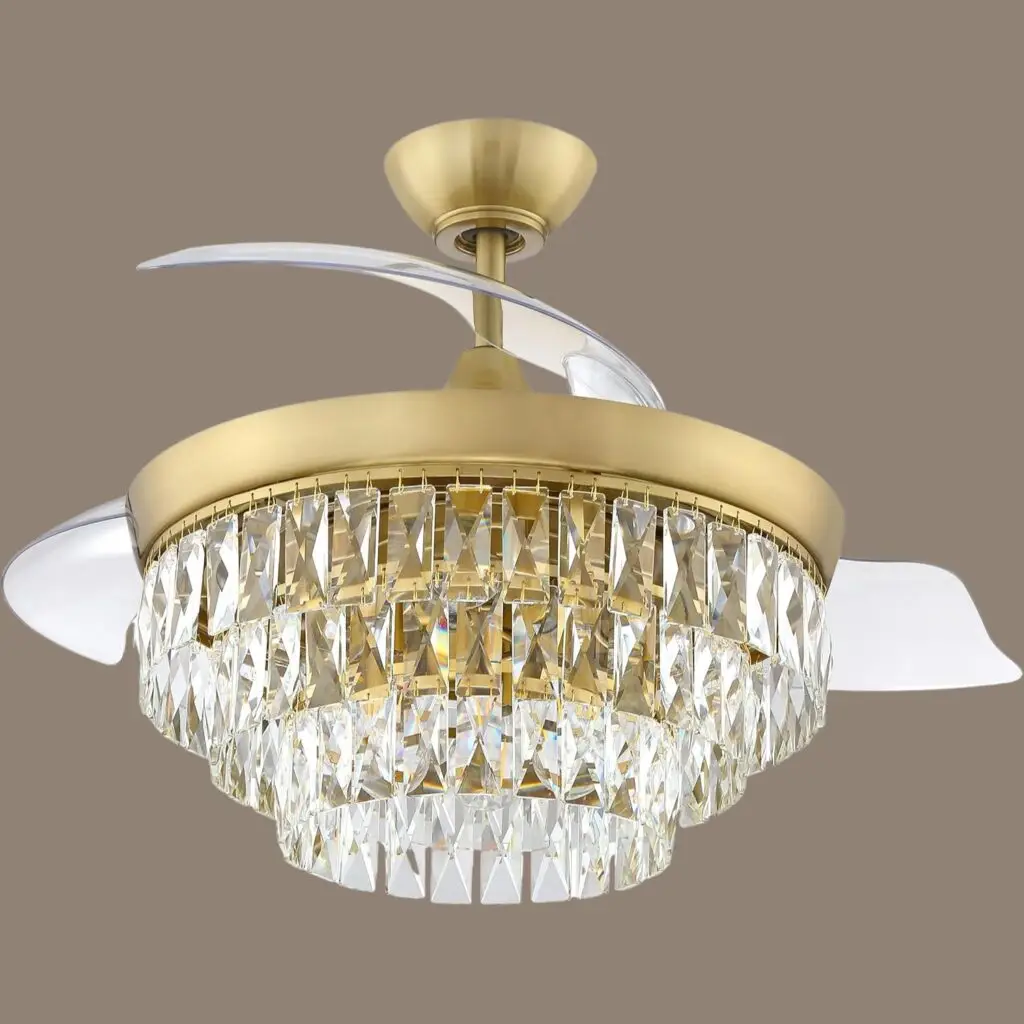
12. Craftmade Sofia 42″ Fandelier in Satin Brass
Three tiers of faceted crystal drops, satin brass frame, hidden retractable blades. When the blades tuck, this reads as a full chandelier, not a modern ceiling fan. Smart WiFi, remote, dimmable 3000K integrated LED. The right pick for a room or space that needs a breeze, but also deserves some sparkle.
$$
Damp rated: No — indoor only
Smart: ✓ Wi-Fi + voice control
Reversible: ✓
Airflow: 2,939 CFM
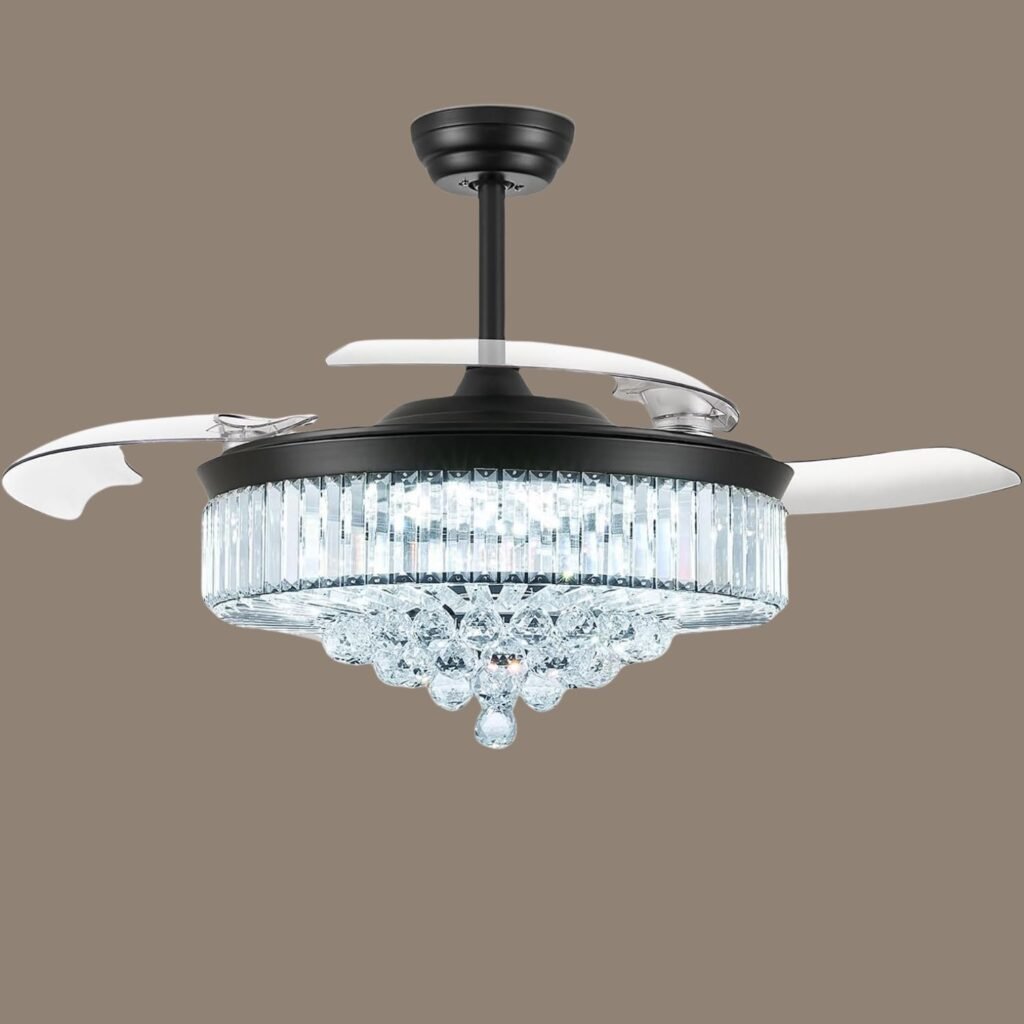
13. FIDGRA 52″ Fandelier Ceiling Fan with Light
Retractable crystal-style chandelier fan, six speeds, dimmable color-changing light, app and remote control — the accessible entry point for rooms where overhead presence and airflow both matter.
$$
Damp rated: No — indoor only
Smart: ✓ App + remote
Reversible: ✓
Airflow: Not specified by manufacturer
When a Ceiling Fan Just Won’t Work
Low ceilings, awkward angles, and spaces in front of HVAC ducts all fight traditional ceiling fan installation. In those cases, a wall fan does the job without the overhead commitment.
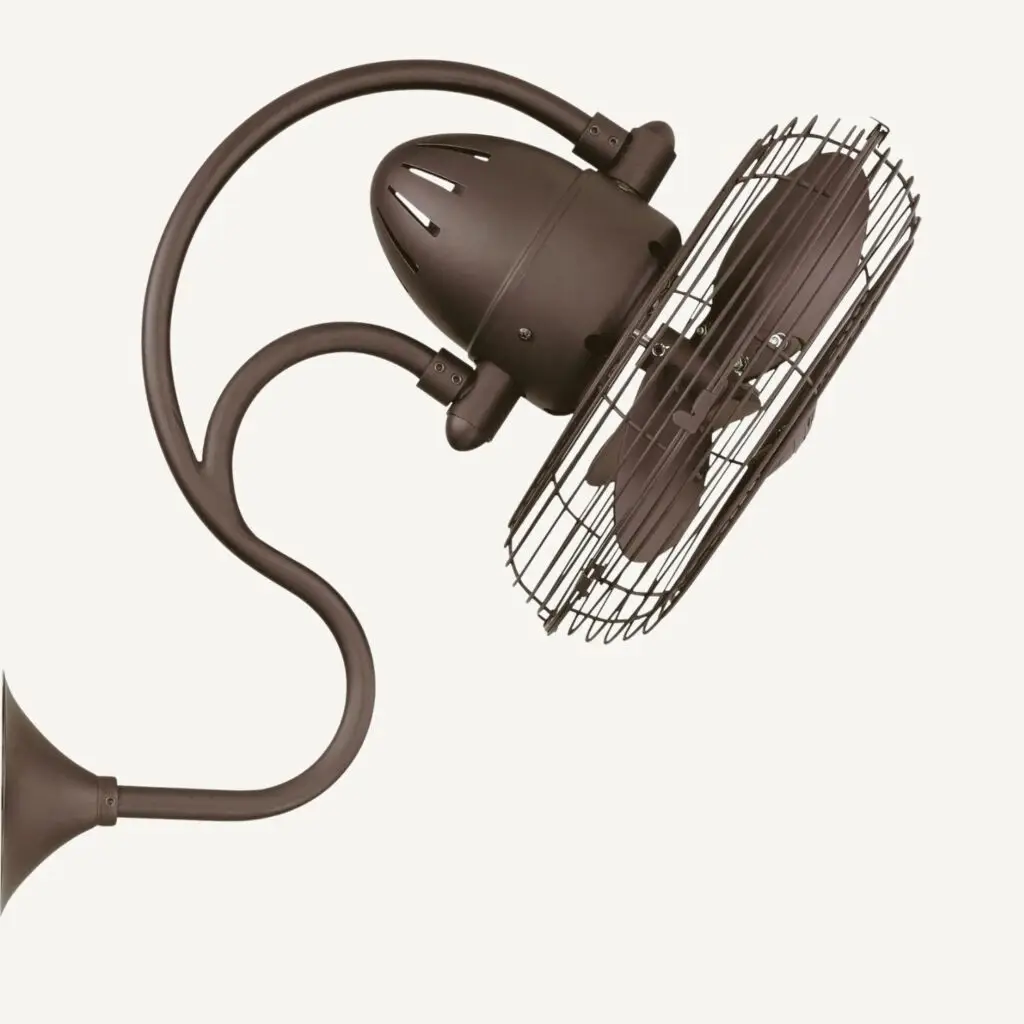
14. Matthews Melody — Wall Fan
Textured bronze, hand-balanced metal blades with decorative guards, three-speed wall control — architectural without being dramatic. Oscillates 90° for multi-directional airflow without the ceiling box.
Damp rated: ✓ (indoor/outdoor)
Smart: No — wall control
Oscillation: 90° left-right sweep
Airflow: 1,303 CFM
Related: Old House Fans That Don’t Need a Ceiling
How to Think About Ceiling Fans in an Old House
Don’t fight the architecture. Feature it. Flat plaster with a medallion? Go invisible or go for modern/historic tension. Vaulted ceiling with exposed beams? Bring in the industrial vibes or warm wood tones. Tongue-and-groove painted white? Almost anything works. Let the rest of the room’s design guide you.
Damp rating isn’t optional in certain rooms. Any bathroom, enclosed porch, or covered outdoor space needs a damp-rated fan. “Dry location only” fans will corrode, seize, or simply fail in humid environments. Modern Forms makes some of the best-looking damp-rated options available. If your fan is going in a humid spot or outdoors, fall in love with a fan that’s rated for the space.
Size matters. Old rooms — high ceilings, plaster walls, wood floors — need more airflow than the fan sizing charts suggest. If the chart says 52″, buy 56″ or 60″. A larger fan moving slowly is quieter, more efficient, and visually calmer than a smaller fan working hard.
Mount type matters for old houses specifically. Vaulted ceilings need a sloped ceiling adapter. Old ceiling boxes may not be rated for fan weight — verify before you install, or replace the box. Not sure about your ceiling box? Calling in the electrician is a great first step.
Which Ceiling Fans Don’t Work in an Old House?
Big Box “Quick Buys” Not because those fans don’t function. Because they communicate “I didn’t think about this room.” That’s never the message you want a ceiling to send.
Faux wood blades. Hollow molded plastic blades in a walnut veneer print belong nowhere near original woodwork, if you’re lucky enough to have it. If you want warmth, buy a fan with real wood. The Fanimation Spitfire uses real wood blades. The difference is immediately visible.
Traditional brass-and-white combos. The curved-blade, antique-brass-and-white fan is designed for a beige builder-grade house built in 1994. It clashes with original period details. I’m not going to pretend I don’t have a few of these around the house that I need to replace.
A fan that fights your room’s design. The ceiling fan is not a rescue operation for a room you haven’t committed to. If you have dark slate floors, the fan should work with them to keep your hard design work cohesive.
An integrated light kit that’s too warm or cold for the room. If your fan needs to do double duty, lighting the space it’s also cooling…you need to be sure you’re happy with the light temperature when the light kit is integrated. Not sure which temperature is right for your room? Learn more about light temperature HERE.
Which Ceiling Fan Should You Pick for an Old House?
If you want the architectural statement: The Matthews Duplo Dinamico — what we have at Rosemont. If that’s outside your budget, the Dagny or the Acqua gets you to the same design language, at a lower (though admittedly not budget) price.
If you want the fan to disappear: Big Ass Fans Haiku L in White. Three blades, no hardware, invisible against a white ceiling.
If damp rating is required: The Matthews Acqua (bathroom or covered porch, with drama) or the Monte Carlo Maverick 88″ (covered porch, with air volume).
If your house has bones and you want the fan to honor them: The Hunter 1886 Limited Edition or the Rejuvenation Heron — period-appropriate material at honest scale.
Frequently Asked Questions: Ceiling Fans for Old Houses
Do I need a damp-rated ceiling fan in an old house bathroom?
Yes, if the bathroom has a shower or tub. Steam and humidity will corrode a dry-location fan quickly. Look for UL/CUL damp rating at minimum. For bathrooms open to outdoor air, wet-rated is the safer call.
What size ceiling fan do I need for an old house room?
Size up from the standard charts. Old houses have higher ceilings, larger rooms, and more air volume to move than modern builds. If the chart says 52″, buy 56″ or 60″. A larger fan moving slowly is quieter, more efficient, and visually calmer than a smaller fan working hard.
Can I install a ceiling fan where there’s no existing junction box?
Not safely, unless you (or your electrician) replace the box. Standard electrical boxes are not rated for fan weight and vibration. Install a fan-rated pancake box or brace kit first. Pre-1940 wiring may also need evaluation before adding a fan circuit.
What’s the difference between a damp-rated and wet-rated ceiling fan?
Damp-rated fans handle humidity and moisture-laden air — bathrooms, covered porches, enclosed outdoor spaces. Wet-rated fans handle direct water exposure — fully open porches with rain exposure. For most old house indoor applications, damp-rated works just fine.