
A converted sleeping porch, a leaky shower, and the tile order that broke my heart — and then made the whole room.
This post is for you if…
- You’re renovating an older home and don’t want it to feel generic or disjointed
- You’re making decisions under pressure (because something broke)
- You care more about getting it right than following trends
Hate the story but want the exact sources?
→ shop the entire project
Some links may be affiliate links, meaning I may earn a small commission if you choose to purchase — at no additional cost to you. I only share products I genuinely like, would use in my own home, or have researched and feel confident recommending.
We didn’t have this renovation in our plans.
But a leaky shower forces your hand. And your wallet.
So we faced facts, and shifted our priorities. From that moment on, the question wasn’t how do we update this bathroom? It was: how do we update it without it looking like a room that belongs in another house?
That’s the old house problem nobody warns you about. A renovation that screams RENOVATION is a (very expensive) failed project.
What we were working with
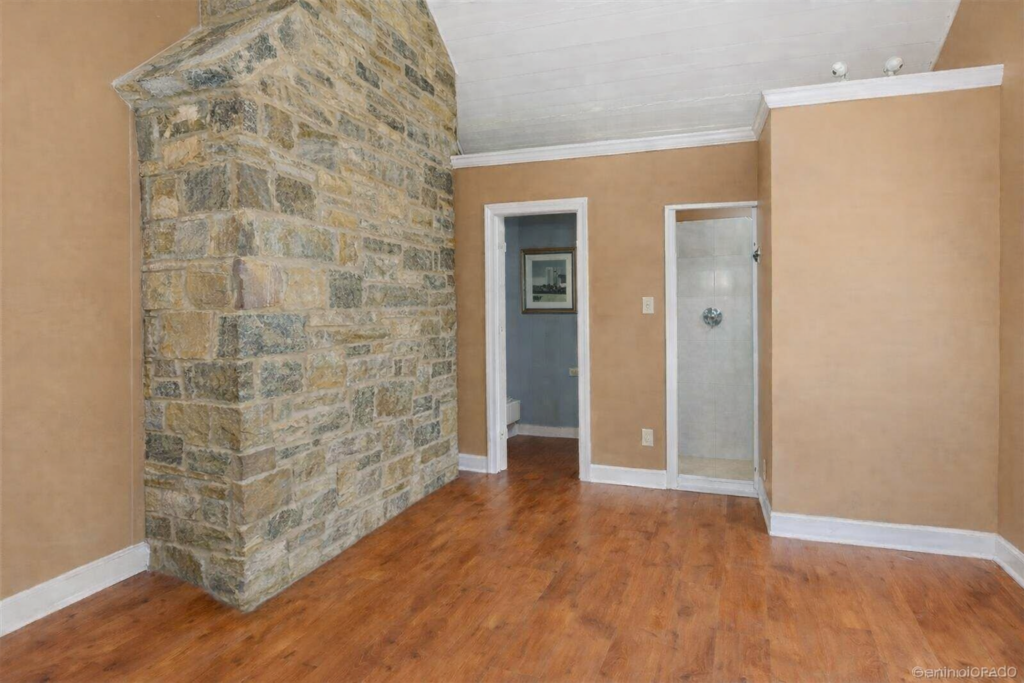
This is what our primary bathroom looked like when we started.
Originally an exterior sleeping porch of this 102 year old center hall colonial, a previous owner converted it into the primary bath years ago.
They put in vaulted tongue & groove celings, wood beams, and french doors that lead to a balcony overlooking a garden.
It’s a room that feels like much more than “just” a bathroom.
Because it used to be the exterior of our home, there’s a massive original stacked stone chimney running floor to ceiling. Local stone. Over 100 years old. Dominant and bossy in a way that cannot be ignored.
And at every step of the planning process, people helpfully suggested ways to “deemphasize” this historic feature.
I didn’t listen.
My take: original features aren’t problems. They’re the brief.
That said, though, the existing orangey floors were a problem. The only laminate in the entire house. Every other room has hardwood – some of it original. The other bathrooms have original 1920s stone floors.
This primary bathroom had been renovated in the nineties — and it showed.
Original chrome Hajoca fixtures and stone floors in the other bathrooms pointed me in the right direction. My job was to use those original rooms as my compass.
When ‘Plan A’ broke my heart
Almost immediately, I found the right tile.
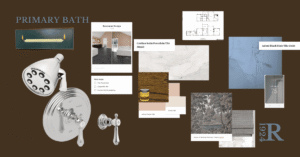
It was a really well-done stone-look porcelain that echoed the original flagstone floors in the other bathrooms. I built the mood board. I did the AI mockup with my actual room photos. I could see it.
And I loved the vision.
Then “the” tile arrived damaged. And was on backorder (at the time of this post, it still is). We found the damage when the installer was on site, ready to put the floors in.
So I made yet another unexpected decision.
I paused and pivoted.
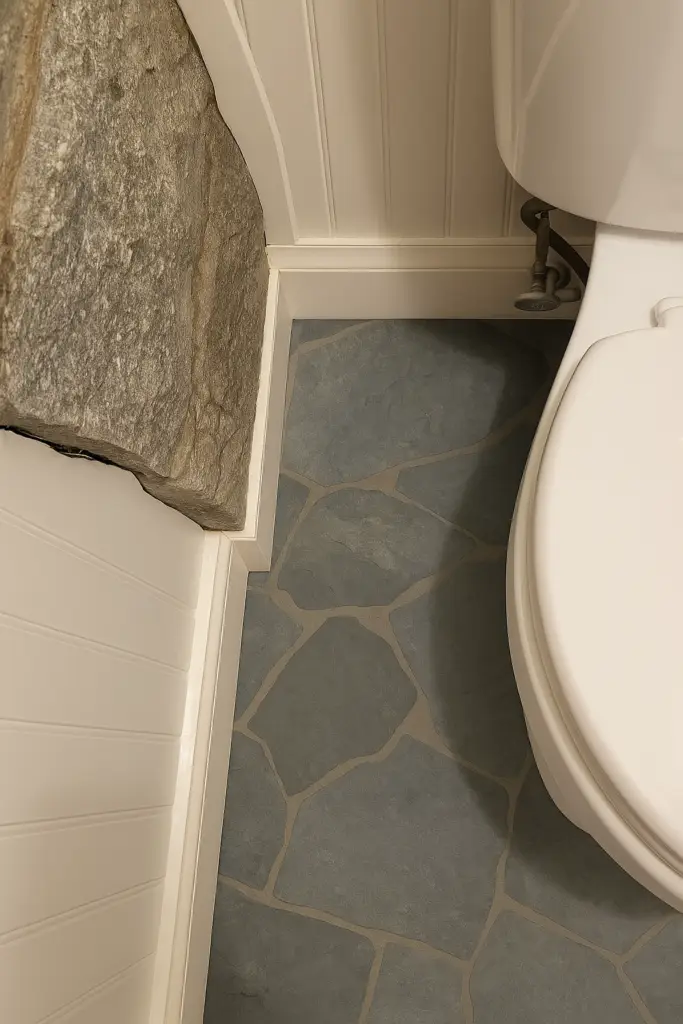
Mockup: Pathstone Grafito Gray Textured Matte Porcelain Flagstone Tile [tilebar]
Turns out, that pivot made the whole room
I hated to change from the stone look tile. But after tile shopping everywhere all the time, I couldn’t find anything I liked. And I really, REALLY wanted to take a shower. And not sleep in a construction zone.
As soon as I saw the Adoni Black slate, I was sold.
But it forced NEW design decisions. The tongue-and-groove tub surround I’d planned, in keeping with the sleeping porch-converted-to-bathroom vibe? It just didn’t make sense.
My samples… and then my mockups helped seal the deal. We could see the slate working with the chimney. The original stone-look tile would have competed.
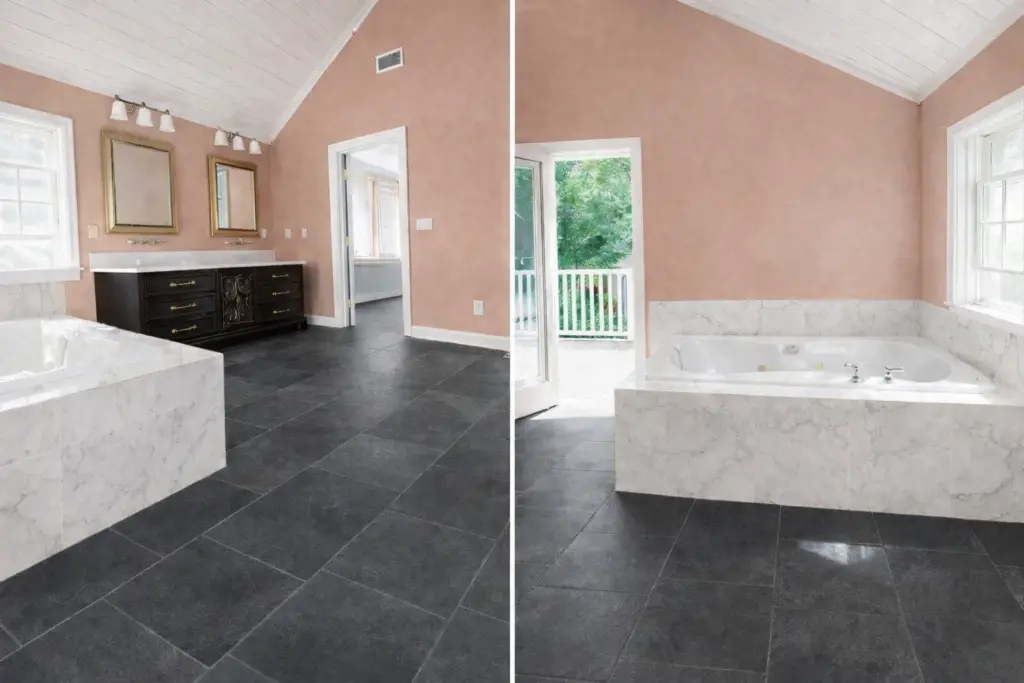
So we ended up cladding the entire bathtub in the shower tile. A large format, really pretty Cortina Satin Porcelain from Floor & Decor instead — the marble-look tile I’d originally chosen for the shower, would now meet up with the slate floor beautifully.
And the stacked stone chimney became the rightful star of the room.
Mockup: Cortina Satin Surround, Adoni Black Slate floors, vintage vanity
Old houses reward flexibility and attention to history.
When the plan breaks, sometimes the pause is exactly the reset to listen to what the house is telling you a little more closely.
What we got right
We did the research.
Before any finish decision was final, I used the house’s own history as the filter. The Hajoca chrome fixtures in the other bathrooms. The original 1920s stone floors. The specific character of a converted sleeping porch with a 100-year-old chimney as its centerpiece. Every choice got held up against what was already true about this house.
We found the fixtures that looked and felt right on point.
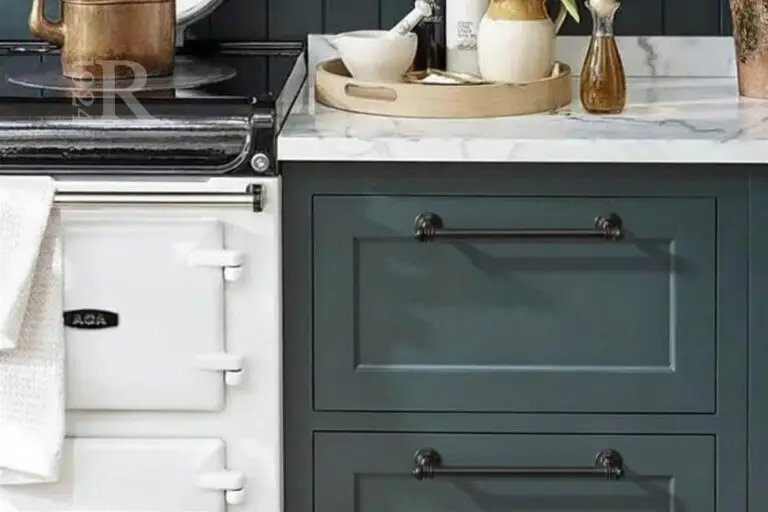
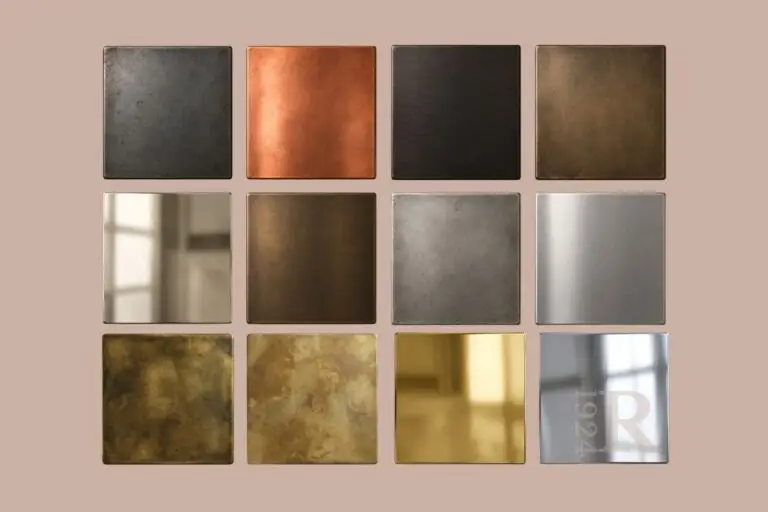
Newport Brass Chesterfield in polished chrome. Chrome may not be the most-pinned finish on Pinterest right now, where brass is reigning supreme. But it’s absolutely right for this house. It speaks the same language as the original fixtures in the other bathrooms — and that matters more than today’s trending metal to me.
This line isn’t the cheapest, but it’s absolutely not the most expensive. And it’s solid brass, heavy, substantial, and feels incredible. It’s something I’ll touch every day, and I love how substantial every bit of this line feels.
We designed a harmonious palette.
One that worked with the room’s history.
- Paint (walls): Farrow & Ball Setting Plaster
- Vanity: vintage piece revived with Dixie Belle Silk All-in-One Mineral Paint – Anchor
- Blinds: Natural Woven Shades in slate and neutral weave [similar]
- Threshold step: DIY Oak finished in Jacobean to match the original hardwood in our adjacent bedroom
We splurged where it mattered.
Heated floor. AMAZING. Full stop. It’s literally my favorite bit. And you can’t even see it. But you sure can feel it. Immediately.
Our system has a touchscreen and is wifi enabled. It’s from Schluter systems and I couldn’t recommend it more. This room gets very, very cold. Every winter, without fail. Having a heated floor is a one-time investment I would have regretted skipping every January for the rest of my time in this house.
We saved where we could.
The bathtub stayed, but it got a glow up.
We kept it because we use it maybe three times a year, and similar jetted soaking tubs cost $$$$. Painting the jets and cladding the surround completely gives it a second life without the cost of replacement. Not everything needs to go to feel new.
Visualization: The step I’d tell you not to skip.
Before any decision got finalized, I built a mood board in design tool Milanote and used AI — ChatGPT and Gemini — to mock up the actual room using my real photos and the finishes I was considering.
For me, this is a huge upgrade over Pinterest alone. By putting your specific room in front of you with your actual choices applied to it, you can feel confident the choices you’re making work. It’s how I saw the original porcelain tile working in the space before I ordered it.
And it’s how I knew — even before the slate got to us — that the pivot was right. Visualize before you order anything. It will save you from at least a couple regrettable decisions.
Old House Rules
A few things I’d do differently — and a few I’d fight for.
Match expertise to scope.
The contractor who handled the original shower repair was not the right person for a full renovation. We knew it. We almost ignored it anyway. When the job grows, the team has to grow with it. Find the specialist who loves old houses. They exist and they’re worth finding.
Don’t rush the finish line. We let the crew work too late one night to “finish” the tile. Mistakes were made. A rushed finish shows up every single day after. Give the end of the project the same patience you gave the beginning.
Know where to invest and where to hold back. The heated floor solved a real, recurring problem — worth every dollar. The bathtub wasn’t broken — it needed a glow-up. Spend where it changes your daily life. Hold back where it doesn’t.
Don’t fight the truth of the house. The chimney is local stone, over 100 years old, and structurally dominant. I designed around it as the anchor it is. Your house’s strongest features are not problems to solve. They’re the brief.
Flexibility beats certainty. The tile I planned arrived damaged. The room I got is better than the room I planned. Stay attached to the outcome, not the plan.
We’re not finished. Yet.
Full reveal coming soon. What’s in place already is more than I’d hoped for from what started as a forced repair.
That’s usually how it goes with old houses. You fix what breaks. You stay flexible. And somehow you end up somewhere better than you planned.
These houses have been around longer than we have. Respecting our elders pays off. For how we live in the house while its ours, and how we leave it for the next owners.
Shop this project
Some links may be affiliate links, meaning I may earn a small commission.
- I use Milanote to get my visualization on. It all starts with the mood board.
- Adoni Black Slate Tile (16×16 & 2×2) from The Tile Shop. I am 100% obsessed with the look and feel of this stone. Simple, but honest and right for this house.
- Cortina Satin Porcelain (30×60) from Floor & Decor is textured, understated, and almost fools the eye. We used a near color-match grout for a monolithic look.
- Newport Brass Chesterfield fixtures feel amazing and substantial to the touch. Hotel-good quality and period correct.
- Farrow & Ball Setting Plaster‘s mineral glow is something magical. Somehow a neutral, but still blush.
- Dixie Belle’s Silk All-in-One Mineral Paint in Anchor is easy to apply, and hard as nails.
- Schluter systems heated floor system almost makes me excited for next winter? A well-worth-it one time splurge I’d give a 10 out of 10.