
There are plenty of renovation upgrades that fall into the “nice but unnecessary” category. Heated bathroom floors are not always one of them.
This post is for you if…
- You’re renovating an older home trying to decide whether heated bathroom floors are worth the expense
- You’re interested in how much heated floors add cost or complexity to the project
- You want a breakdown of the radiant floor options you can use
Hate the story but want the exact sources?
→ shop the entire project
Some links may be affiliate links, meaning I may earn a small commission if you choose to purchase — at no additional cost to you. I only share products I genuinely like, would use in my own home, or have researched and feel confident recommending.
Winter in an Older Home can be a Constant Battle for Warmth
In an older home, especially one with exterior walls and inconsistent heating, a tile bathroom floor can feel genuinely uncomfortable for half the year. And once you’ve experienced a cold bathroom first thing in the morning in January, you realize this isn’t really about luxury — it’s about solving a daily friction point.
We debated heated floors for our 1924 house longer than almost any other bathroom decision. It felt like a splurge. But once we looked at the actual conditions of the room, the decision became clearer.
If you’re renovating an older home bathroom and trying to decide whether heated floors are worth it, here’s the framework we used.
The Real Question: Are You Fixing a Comfort Problem?

Heated floors make the most sense when they solve an issue — not when they’re added simply because they sound appealing.
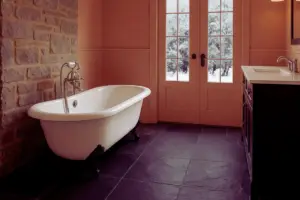
Our bathroom sits on two exterior walls, has no radiator, and previously had laminate flooring that never felt especially warm. During our unexpected-but-necessary renovation we were already planning to install tile across most of the footprint, which would have made the room noticeably colder.
The bathroom is also larger than typical at roughly 235 square feet, so the amount of tile surface area mattered. A small powder room might not justify the cost. A large primary bathroom you use every day is a different equation – especially when it gets really, really cold.
In other words: We weren’t adding heat to a perfectly comfortable room. We were solving a real, predictable problem.
A very cold room with no trusted heating source (we use radiator, not forced air heating) in the dead of winter.
Why Heated Floors Often Make Sense in Older Homes
Older homes are known to be very (very) drafty. They rarely distribute heat as evenly as newer construction. Radiators are often positioned based on historical layouts, insulation varies widely, and rooms with exterior walls tend to experience more temperature fluctuation.
Bathrooms can be even more vulnerable because:
- Tile holds cold temperatures longer than wood or laminate
- Bathrooms are often located on exterior corners of the house
- Many historic homes have limited dedicated heat sources in bathrooms
- Morning use magnifies discomfort
When a bathroom is already being renovated and tile is being installed, adding radiant heat becomes significantly easier and more cost-effective than retrofitting later.
And once the floor is closed up, adding heat later becomes exponentially more disruptive. Don’t miss the opportunity if you get it.
Our Decision Criteria
We ultimately decided heated floors were worth the investment in this room because several factors aligned:
The room is genuinely cold
Two exterior walls and no radiator meant winter mornings were predictably uncomfortable. And pipe were more at risk due to the ambient temperature of the room.
We were already replacing the floor
The bathroom previously had laminate flooring, so installing tile already required full floor preparation. We weren’t removing historic materials to add heat.
It’s a high-use room, and sets the tone of my day. Every day.
Primary bathrooms are used multiple times daily, making comfort improvements more noticeable. My morning starts very early, before sunrise, with a shower. That’s not a fun or comfortable situation in a room under 50 degrees Fahrenheit.
It’s a big room
And approximately 90% of the walkable floor space is heated, including the main circulation areas, shower perimeter, and water closet area. That’s a lot of floor to feel miserable about. We skipped heating under the tub and vanity. It added cost, but we were thoughtful about only heating areas we would touch.
We could offset the splurge elsewhere
By keeping and refreshing the existing tub and vanity, both in good condition, we freed budget for an upgrade that would change the day-to-day experience of the room.
Sidebar: DIY vs. Pro Installation
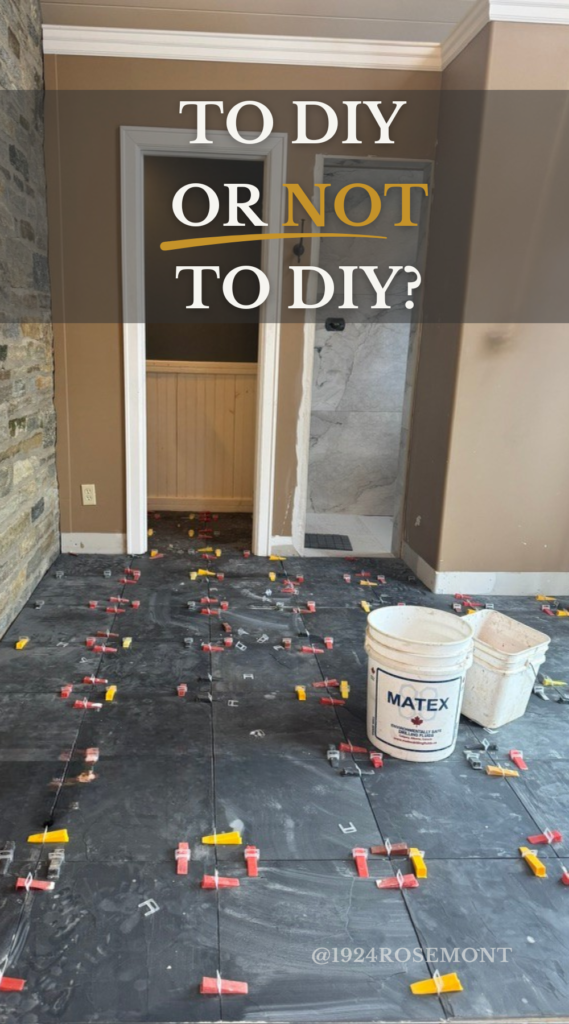
For most bathrooms, the materials for electric heated floors cost about the same whether you install them yourself or hire it out — the difference is what you’re adding to labor costs.
In an average-size bathroom, having a tile installer and electrician manage the full installation can push the heated floor portion of the project into the high hundreds or low thousands of dollars.
Installing the heating mats yourself and hiring an electrician only for the final electrical connection can often reduce labor costs by 30–50%.
The practical takeaway: if you’re already comfortable installing tile, a partial DIY approach can meaningfully lower the cost barrier without changing the finished result.
Electric radiant systems are generally considered one of the more approachable upgrades for experienced DIY renovators because the heating mats are designed to be cut and fitted around fixtures before tile is installed.
Installation Reality: Plan Carefully
Radiant floor systems are reliable, but they do require careful installation.
Once tile is installed, accessing the heating cable becomes significantly more complicated. The system is covered by tile and thinset. This means layout planning and coordination with your tile installer are critical.
During our installation, two tiles needed to be removed after placement due to damaged tiles set in the center of the room. The contractor carefully removed the tiles, tested the heating system before reinstalling, and confirmed the system was still functioning correctly.
Moments like this reinforce why experienced installers and proper testing procedures matter. Most systems include testing tools that allow the installer to confirm the cable has not been damaged during installation.
Repair kits do exist if damage occurs, but prevention is (obviously) preferable.
Comparison: Popular Electric Heated Floor Systems
Schluter Ditra-Heat
(What We Chose)
- Cost: $$$
- Format: Cable + uncoupling membrane
- Best for: Tile renovations where waterproofing matters
- Pros: Combines uncoupling + heat, trusted by tile pros
- Considerations: Higher upfront material cost
Warmup DCM-Pro
- Cost: $$$
- Format: Cable + membrane
- Best for: DIY-friendly layouts
- Pros: Flexible cable spacing, strong warranty
- Considerations: Requires layout planning
SunTouch Mat
- Cost: $$
- Format: Pre-spaced mat
- Best for: Simple rectangular rooms
- Pros: Faster install, widely available
- Considerations: Less flexible around obstacles
Nuheat Mat
- Cost: $$$
- Format: Custom-sized mat
- Best for: Precise room dimensions
- Pros: Pre-sized mats simplify installation
- Considerations: Custom sizing increases cost
Total costs will depend on: room size, coverage percentage, your thermostat choice, membrane inclusion, and brand warranty level.
Noteworthy: I’m not a flooring expert or professional, just a dedicated and slightly research-obsessed homeowner, passing along what I learn along the way.
Heated Bathroom Floors: The Pros and Cons
Pros
Undeniable comfort improvement
Stepping onto a warm tile floor in the dead of winter makes my bathroom bearable, and helps me start my morning on the right (warm) foot.
Invisible modern upgrade
Heated floors preserve the visual character of an older home while improving livability.
Flexible coverage
Heating cables can be routed to prioritize where you walk instead of heating the entire footprint.
Cons
Cost adds up in larger rooms
Material and labor costs scale with square footage.
Installation requires precision
Careful layout planning is important to avoid damaging heating elements.
Repairs require demo for access
Any future cable damage typically requires tile removal in the affected area.
Typical Cost Range

Electric radiant floor systems typically cost between $10–20 per square foot for materials, with total installed costs commonly landing between $800 and $2,500+ depending on:
- bathroom size
- system type
- electrical complexity
- labor rates
- tile scope
Larger bathrooms increase cost but also increase perceived value, since more of the daily walking surface is heated.
Many homeowners find the upgrade easiest to justify when the floor is already being replaced.
Would We Do It Again?
One million percent, YES!
But context matters.
We’d absolutely install heated floors again in a room that:
- is genuinely cold in the winter
- has substantial tile coverage
- is going to be fully renovated anyway
- is used daily
We’d never rip out original historic tile or stone just to add radiant heating.
As with so many renovation decisions, context determines value.
In our (very) cold older home bathroom, heated floors feel less like a luxury and more like we’re fixing a flaw in how our house lives to feeling like a practical improvement.
Heated Floor FAQs
Do heated bathroom floors warm the room? Or just the floor?
They primarily warm the floor surface itself, but in a smaller bathroom the radiant heat can raise the ambient room temperature slightly, too. In a larger room like ours (about 235 square feet) the effect is more localized to where you’re standing, but that’s honestly exactly where you want it.
Are heated floors safe under tile?
Yes, when installed correctly. Always confirm your tile is rated for use with radiant heating systems. Natural stone, porcelain, and ceramic all generally work well. If you’re using natural stone, confirm with your installer. Thicker stone like slate takes longer to heat up but retains heat better and longer than porcelain once it gets warm.
Will having heated floors increase resale value?
In cold-weather markets and older homes where comfort is already a selling challenge heated floors tend to land well with buyers as a visible, tangible upgrade. It’s less about appraisal value and more about buyer perception. A warm floor in January during a showing is a memorable detail.
Do heated floors use a lot of electricity?
With a programmable thermostat and sensible scheduling, most homeowners find the impact manageable. The key is not running the system continuously. Set it to heat during your actual usage windows, typically an hour in the morning and an hour in the evening, and your impact stays reasonable. Larger rooms with thicker stone will use more energy to reach temperature, but the longer heat retention means you don’t need to run the system as long to get the benefit. For our 1924 Old House, that room has been unpleasantly cold in the winter, so having the heated floors makes my morning routine (much) less cold.
Does slate tile heat differently than porcelain tile?
Yes, and that’s worth knowing before you choose your tile. Our slate is roughly twice the thickness of the porcelain we’d originally planned to use, which means it takes more time to reach temperature. The tradeoff is that it holds heat much longer once warm, so the floor stays comfortable well after the system cycles off. For a programmable thermostat setup if you go that route, you’ll want to account for that ramp-up time in your schedule.
What thermostat should I use with a heated floor system?
We chose the Schluter Ditra-Heat-E-RS1 Smart Thermostat, which is wifi-enabled and pairs directly with our Schluter system. A programmable or smart thermostat is worth the investment, if it’s in your budget. It lets you set the floor to warm up before you’re out of bed and turn off after your morning routine, which keeps electricity usage manageable. Running heated floors all day in a room you use for 30 minutes is how the electricity bill becomes something to complain about.
Can older homes handle the electrical requirements of heated floors?
This is the exactly right question to ask before you start. Radiant floor systems require a dedicated circuit, and older homes often have wiring that predates modern electrical loads. We treated this project as an opportunity to rewire the bathroom entirely, adding a new circuit, new wiring, mapped by our electrician before any work started. If your older home hasn’t been updated, budget for an electrician assessment before you commit to heated floors. It’s not a reason not to do it, it’s just part of the real total cost.
Shop This Project
Some links may be affiliate links, meaning I may earn a small commission.
- Schluter systems is the system we chose to heat our frigid floors. A well-worth-it one time splurge I’d give a 10 out of 10.
- Adoni Black Slate Tile (16×16 & 2×2) from The Tile Shop is the tile we’re heating. I am 100% obsessed with the look and feel of this stone. Simple, but honest and just right for this house.
- STONETECH Bulletproof Sealer is the sealer we used to keep the floor protected without a huge change to the color or sheen.
- DCM-PRO Systems [evaluated, not right for our project] See comparison chart for details
- SunTouch CommandPLUS Floor Heating Systems [evaluated, not right for our project] See comparison chart for details
- NUHEAT nVent Radiant Floor Heating kit [evaluated, not right for our project] See comparison chart for details