

If your home feels slightly “off” at night – more MEH than cozy – there’s a good chance the issue isn’t your furniture or your wall color. It might just be your choice of light bulbs.
This post is for you if…
- You’re not sure which lightbulb to use where
- You’ve got your whole house’s light fixtures selected, and something still feels “off”
- You want your old house (or collected house) to glow, but have no idea how to start
Hate the story but want the exact sources?
→ shop the story
Some links may be affiliate links, meaning I may earn a small commission if you choose to purchase — at no additional cost to you. I only share products I genuinely like, would use in my own home, or have researched and feel confident recommending.
Cozy isn’t cold. It’s all about warmth and comfort.
One of the most common mistakes people make when updating an older home is choosing bulbs based just on brightness instead of considering color temperature — and the emotional effect that temperature creates.
In houses with original character — plaster walls, wood floors, aged brass, vintage pieces, layered textiles — lighting isn’t just functional, it shapes the entire feeling of the home. And if you’re adding character into a newer home, lighting is just as important.
Warm light enhances depth. Cool light flattens it.
Once I began paying attention to Kelvin temperature, my rooms felt calmer, more cohesive, and more welcoming — especially in the evening.
This is the practical guide I use at 1924 Rosemont when deciding between 2200K, 2700K, and 3000K bulbs.
And how smart bulbs make tuning lights to suit the moment easier than ever.
Related: want to focus more on mixing high- and low-end lighting fixtures in your home? Then this story is for you!
Quick Guide: Warm Light Color Temperatures
Kelvin (K) measures the color of light.
Lower numbers feel warmer and more amber.
Higher numbers feel cooler and more blue.
It can feel counterintuitive at first:
lower number = warmer light
higher number = cooler light
Think of it this way:
candlelight is very warm → 1800K
midday daylight is much cooler → 5000K
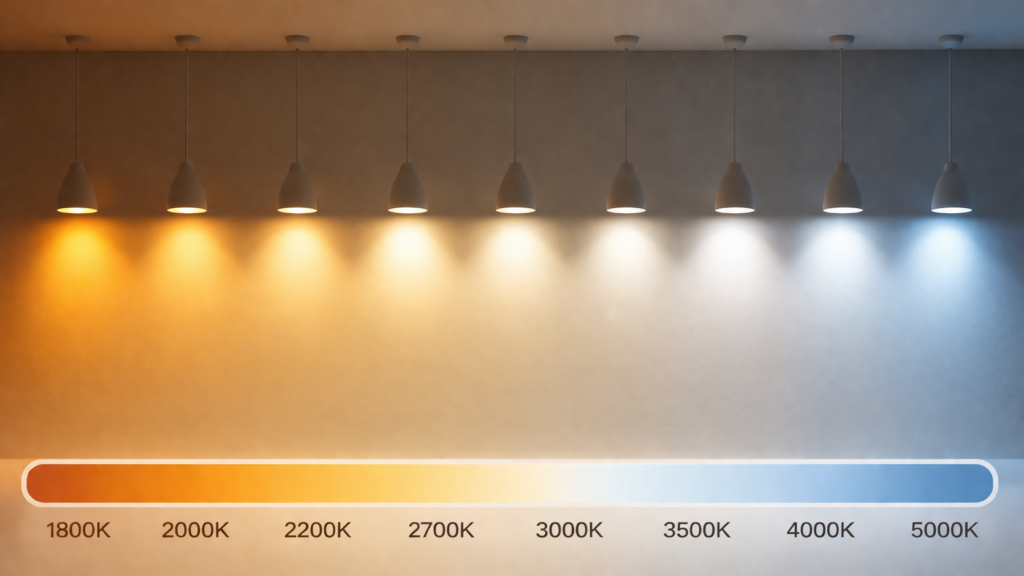
As Kelvin numbers get higher, the light tone shifts from soft amber to crispy, cool white. You absolutely don’t need to memorize the Kelvin scale — you just need to know which range helps you get the feeling you want for your home.
2700K: The Foundation for Most Rooms
If you could only choose one color temperature, I’d recommend 2700K. Why? Because it’s warm enough to feel comfortable, and neutral enough to work across multiple rooms.
2700K works beautifully in:
- living rooms
- bedrooms
- hallways
- dining rooms
- entryways
It’s super complimentary to wood tones and natural materials and helps maintain continuity as you move through the house. And that continuity is really important. Lighting should feel connected from room to room.
Where light falls on the Kelvin scale sets the mood in the room. For example, if you’re in a wonderfully lit dining room, and step into a much cooler-lit kitchen, that shift feels really jarring.
And in older homes, or any homes where sightlines let you see from room to room, into multiple spaces at once, the warmth of the lighting needs to flow. To feel intentional and set a ‘visual temperature’ that doesn’t have hot spots or cools spots unintentionally.
Defaulting to 2700K helps keep everything feeling intentional. But you don’t have to stop there.
2200K–2600K: For the Warmth, Depth, and Evening Glow-y Vibe

Very warm bulbs add in the softness and glowy cozy. You probably won’t have the only light source in a room filled with 2200K bulbs, but in layered lighting, you’ll pop in a few warmer bulbs as part of a layered lighting story. I use warmer bulbs mostly in overhead chandeliers and lamps on dimmers. I’ve had really great luck with Phillips dimmable LEDs with the “warm glow effect”.
They’re LEDs that give warmer light as you dim them, starting at 2700K and dimming to 2200K. I’ve put them in our entry, dining, and living room chandeliers and the glow they put off at the dimmest level is liquid amber.
As the light dims, the color temperature warms toward candlelight. You’ll never use just the overhead lights at their dimmest, but you’ll look amazing and so will your room.
Their effect is subtle but powerful: light gets more localized, contrast softens, and the light is pure amber.
If you love how restaurants feel in the evening, lighting warmth is often why.
Warm light is emotional comfort. And your home should be completely welcoming at night. Using lightbulbs in this range helps to add to that feeling.
3000K: Helpful Where Clarity Matters
3000K sits just slightly cooler than 2700K.
Depending on your home, this less-warm light can be useful in task lighting, kitchens, bathrooms, or work areas where visibility matters — but it works best when integrated thoughtfully with warmer lighting nearby. The key? It’s balance.
If a kitchen opens directly into warm living space, using 3000K+ everywhere in the kitchen will make a transition from 2700K-lit rooms feel too jarring.
Instead, consider using 2700K ambient lighting (or “tuneable lighting”), and add targeted task lighting where clarity matters. In our kitchen, most of our lighting is warm at 2700K, but we rely on more focused, slightly cooler (3000K) task lighting in our range hood when cooking.
Task lighting should support you in the task at hand without overwhelming your atmosphere. Or making you feel like you’re in an office building.
Why Cooler Lighting Can Feel So Wrong in Older Homes
Older homes a rich with depth and variation: wood grain, aged finishes, plaster texture, collected materials, and vintage elements. And cool lighting tends to flatten these layers.
Instead of highlighting texture, cool, blue-hued lighting reduces contrast, adds a sense of starkness.
Don’t get me wrong, cooler light definitely has its place in the home — garages, basements, task-heavy environments — but using is broadly in living spaces can strip away the softness and cozy that makes a home feel … homey.
Plus, warm light tends to be more flattering. And feeling pretty and cozy in a space you’ve worked hard to get just right is important.
When the bulb is part of the design
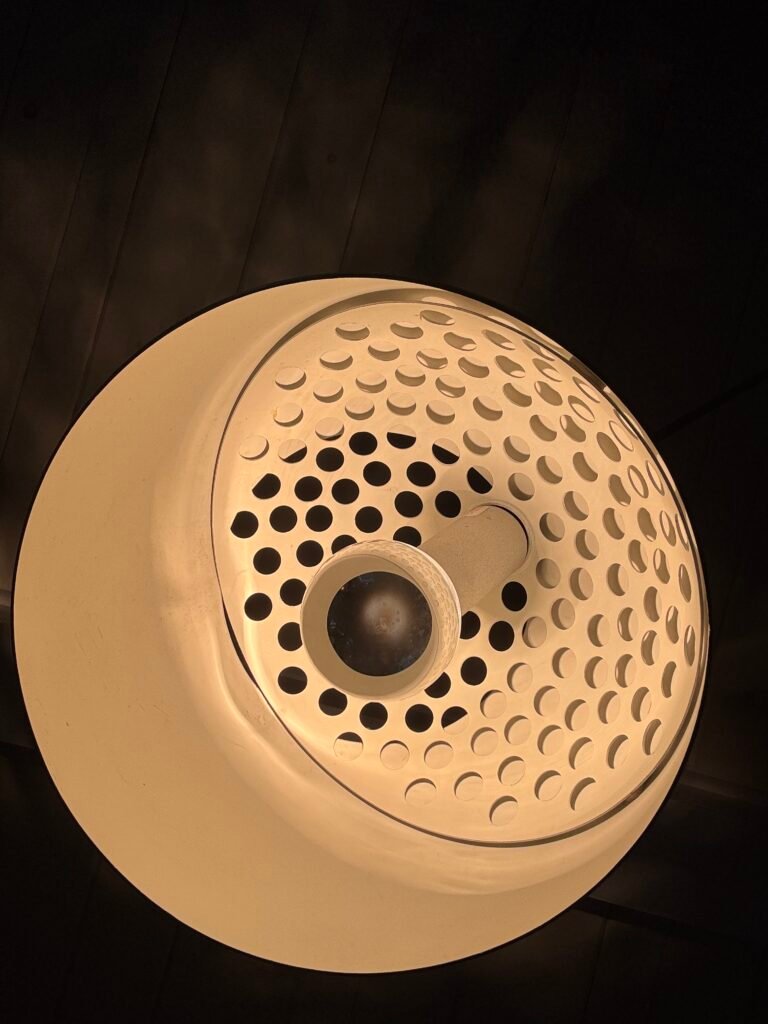
Some fixtures aren’t even trying to hide the bulb.
They’re designed to merge with it. Then deliver an experience that’s really, truly special.
Our vintage Flos Arco floor lamp uses a half-chrome globe bulb, where the chrome coating reflects light back into the fixture instead of casting it downward. This is a lamp that creates a moment, with a suspended spun aluminum pendant attached to a block of carrarra marble by a cantilevered stainless steel arm.
The Arco throws a warm, diffused glow that adds a focal point to the room without a harsh point of light, and gives a gorgeous uplighting effect to show off a special ceiling moment.
If you have a globe pendant, exposed bulb sconce, or statement floor lamp where the bulb is visible, half-chrome bulbs are worth knowing about. I use Bulbrite’s 100W half chrome globe bulb.
It’s not ONLY about Kelvin, it’s also about where the light gets directed and how the bulb and the fixture come together.
The Real Goal: Layered Lighting

The goal isn’t finding one “perfect bulb”. The goal is creating layers that work for your home, without losing the feeling you’re trying to capture.
Layered lighting includes: ambient, task, and accent lighting. You’ll create the lighting story by relying on levels: floor and table lamps, sconces, overhead lighting. You’ll tailor the story by adding flexibility: lamps (new and vintage), dimmers, motion sensors, and automation.
And that’s a story you can create and edit over time.
In our house:
- living spaces rely on warm ambient light supported by lamps
- kitchen task areas include more focused clarity where needed
- basement lighting leans cooler for visibility (because I hate it down there!)
- and fixtures without switches rely on motion-sensors and smart bulbs
Lighting decisions aren’t about perfection. They are about creating the options that deliver the FEELING of home.
Your home should reflect the way you want to look and feel at home.
Oh, and by the way? Dimmers Change Everything
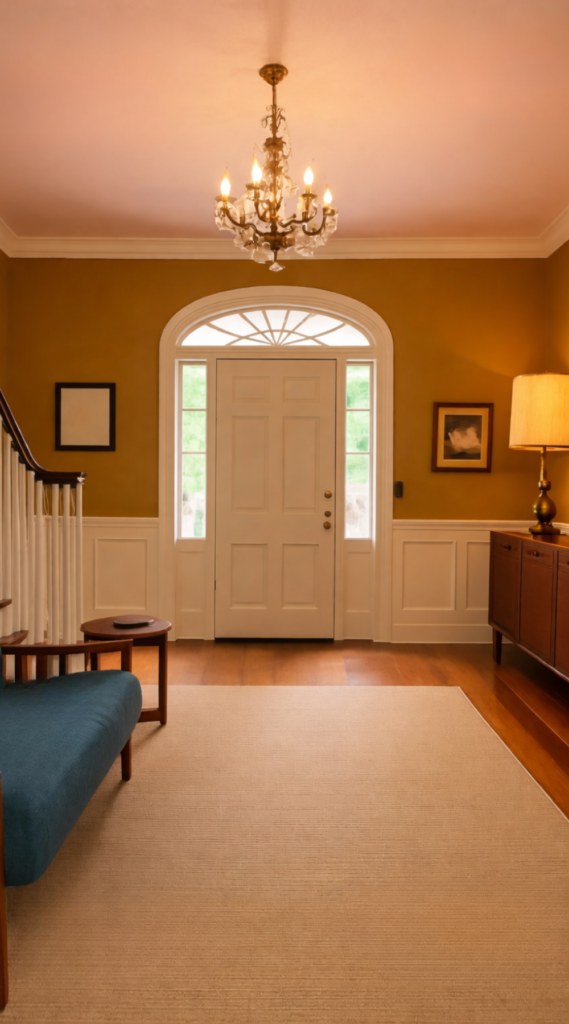
Overly bright rooms aren’t a deal-breaker. In fact, there are times you might want to turn up the brightness.
But having CONTROL over all that brightness is the key.
Dimmers – and smart bulbs – let spaces shift naturally from day to evening. From situations that need more light to situations that should be almost candle-lit.
For exactly this reason, we have 100W Hue Smart Bulbs in our entry console table lamps. We almost NEVER have them at full brightness, but on low-light days, it makes a huge difference to have the heart of our home well lit by 2700K bright lights.
Dimmers let your lighting support mood as well as functionality. When you can’t rewire, having smart bulbs that dim or shift temperature give you the same flexibility on a smaller budget.
Old House Rules: Lightbulbs That Add to Your Lighting Story
- Use 2700K as your go-to default.
- Look to in 2200K–2600K bulbs for visual warmth and atmosphere.
- Use 3000K selectively where clarity matters.
- Don’t rely on cool lighting in character-filled homes.
- Install dimmers (or use smart bulbs) wherever possible for maximium flexibility.
- Consider how lighting transitions between rooms will feel. Limit big Kelvin swings from room to room.
- Choose bulbs based on the feeling you want in the room, not just brightness.
Shop this story
Some links may be affiliate links, meaning I may earn a small commission.
- 100W Phillips Hue Smart Bulbs give you tuneable white LED power you can dim on demand.
- Phillips Hue Smart Bulbs in White Ambience Starter Kit is a perfect way to bring smart LEDs into the lighting picture
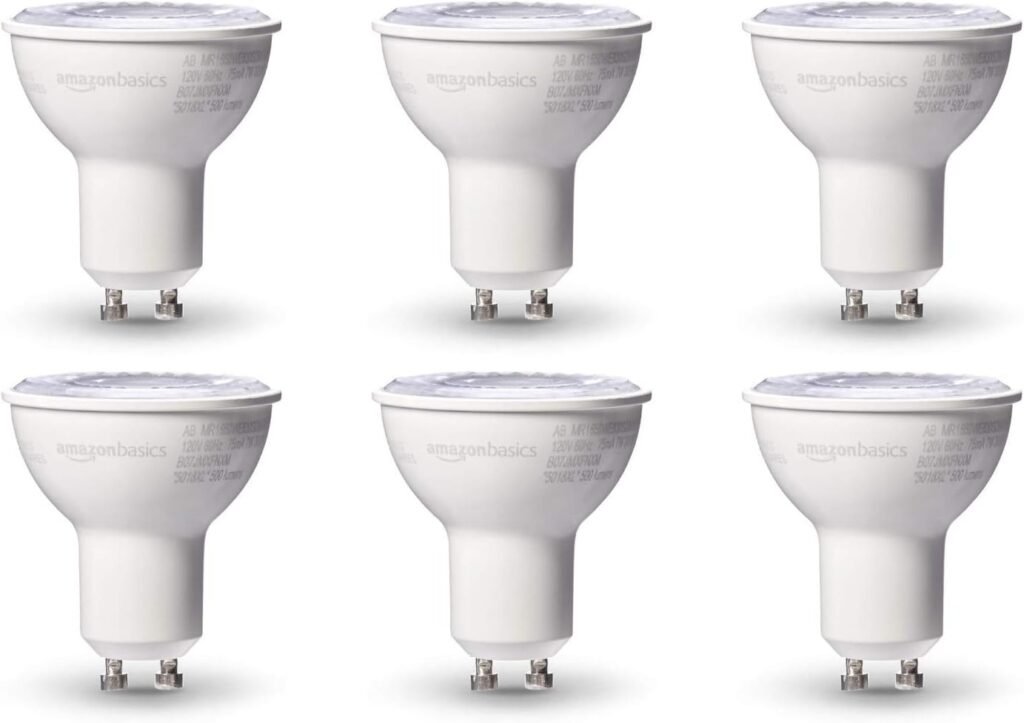
- Amazon Basics MR16 LED, GU10, Dimmable, 3000K deliver focused, clean lighting you can use in task lighting where you need it
- Bulbrite 100G25HM Half Chrome 100W Globe Shape Bulb – 2 Pack the half-chrome finish reflects light back into the fixture instead of straight down, creating a warm diffused glow.
- Flos Arco Floor Lamp an Italian design icon that’s been in continuous production since 1962. If you’re going to have one statement lamp, this is it. Pro-tip: these are hard to come by used, and a real pain for dealers to physically move. I got mine for a steal from a dealer sick of having to pick up this lamp every time he reset his shop.
- Phillips dimmable LEDs with the “warm glow effect” are my Rosemont go-tos for chandelier lighting that gets warmer as I dim it. A great magic trick.
- Situ Lighting: Plug-in Vision Series Remote Controlled LED Art and Picture Light – USA Made – 2700K spendy but worth it to light that special art.
- [Situ look for less] LEONLITE 3CCT Dimmable LED Picture Light, 2700K/3000K/4000K Look for less with tuneable white capabilities.
- Philips Hue Motion Sensor we rely on these where we don’t have wall switches.
- Classic Accents Single Pole Push Button Dimmer Light Switch vintage look, modern dimming.
- Classic Accents Aged Antique Brass 1 Gang Push Button Light Switch Wall Plate a satisfying “THUNK” that makes turning on the lights more fun.