
This Post Is For You If…
- Your fountain pump just died and you want the replacement to be the last one you think about for years
- You’re staring at pump listings full of GPH numbers that mean nothing to you yet
- You suspect the cheap pump and the right pump aren’t the same thing — but you’re not sure where the line is
Ready to jump straight to the shortlist? → get the shortlist or shop the entire project
Some links may be affiliate links, meaning I may earn a small commission if you choose to purchase — at no additional cost to you. I only share products I genuinely like, would use in my own home, or have researched and feel confident recommending.
Choosing the Just-Right Fountain Pump Takes Your Garden From Good to Great

Old Houses sometimes have that type of surprise and delight it’s hard to find in a new build.
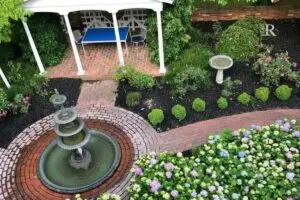
One of our delights is a four-tier fountain that sits in the center of the garden just outside my office. It’s surrounded by brick paving and a huge, happy stand of hydrangeas.
For five years, a pump the size of a brick pushed water seven feet up through its core without one complaint. This spring that pump went to pump heaven.
What really surprised me when I went looking for a fountain pump replacement: the original pump that had survived five years of nearly continuous outdoor duty was a $45 hydroponics pump. Not a fountain pump.
Somebody — a previous owner, a clever landscaper, a resourceful electrician — dropped the undersized Active Aqua grow-room pump into the garden fountain and it just … worked. For years.
There’s a lesson in that, and it’s not “buy the cheapest pump.”
It’s that the brand on the box matters less than the numbers on the label.
Before you buy anything, know the three numbers that decide whether the pump will work in YOUR fountain.
How to Size a Fountain Pump: the Three Numbers That Matter

Vertical rise — measure this first.
From the water surface in the basin to the highest height the water needs to reach. Mine is seven feet.
Rise is the most important number in the equation.
This single number disqualifies most of the budget pumps on Amazon, and nobody tells you that until you’ve bought one that delivers a sad dribble at the top tier.

Max head — get 1.5× of vertical rise.
Max head is the height at which a pump’s flow drops to zero.
A pump “rated” to 10 feet is barely moving water at 9.
The rule: your pump’s max head should be at least one and a half times your vertical rise.
Seven feet of rise means I shop for 11 feet of max head, minimum.

GPH at your fountain’s height.
The gallons-per-hour (GPH) number on the front of the box is measured at zero feet of lift.
Gravity taxes it from there.
Check the manufacturer’s flow chart for output at YOUR height. For my gentle tier-to-tier cascade, roughly 100 GPH per inch of spout diameter at the top is my actual target.
The Shortlist: Fountain Pumps Worth Buying
I’ve done my homework, considering: customer ratings, reliability, value, best for large fountains, and best overall to create this Fountain Pump shortlist.
Have a pump you think should be on this list? Let me know!
Best Overall
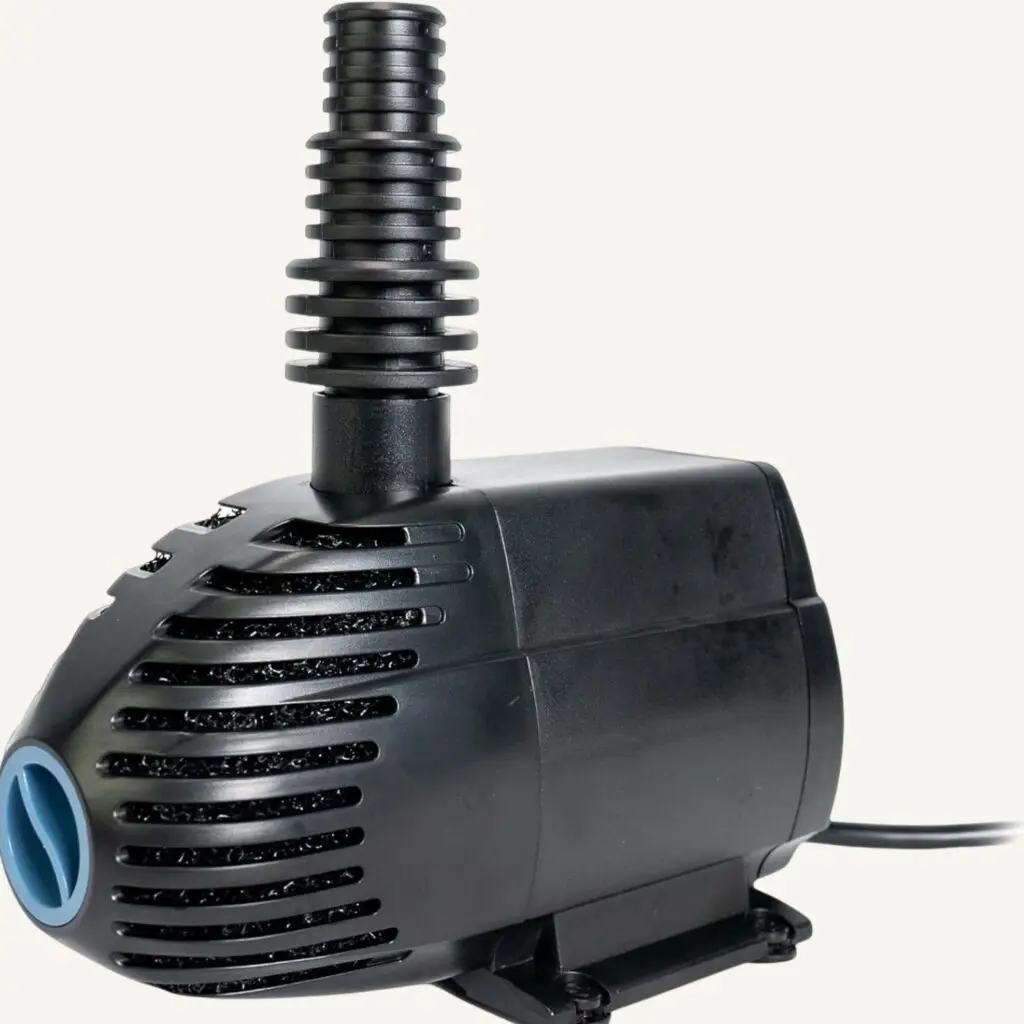
Aquascape Ultra Series
(400–1,100 GPH, five sizes)
~$60–130, Amazon
Mag drive, pre-filter cage, flow control, three-year warranty.
Sizes: the 400 runs tabletop and small statuary, the 550–800 handle one- and two-tier fountains under five feet, and the 1100 — 12-foot max head, 25-foot cord can carry tall multi-tier fountains.
This is what I’ll use in my fountain.
Best for Reliability
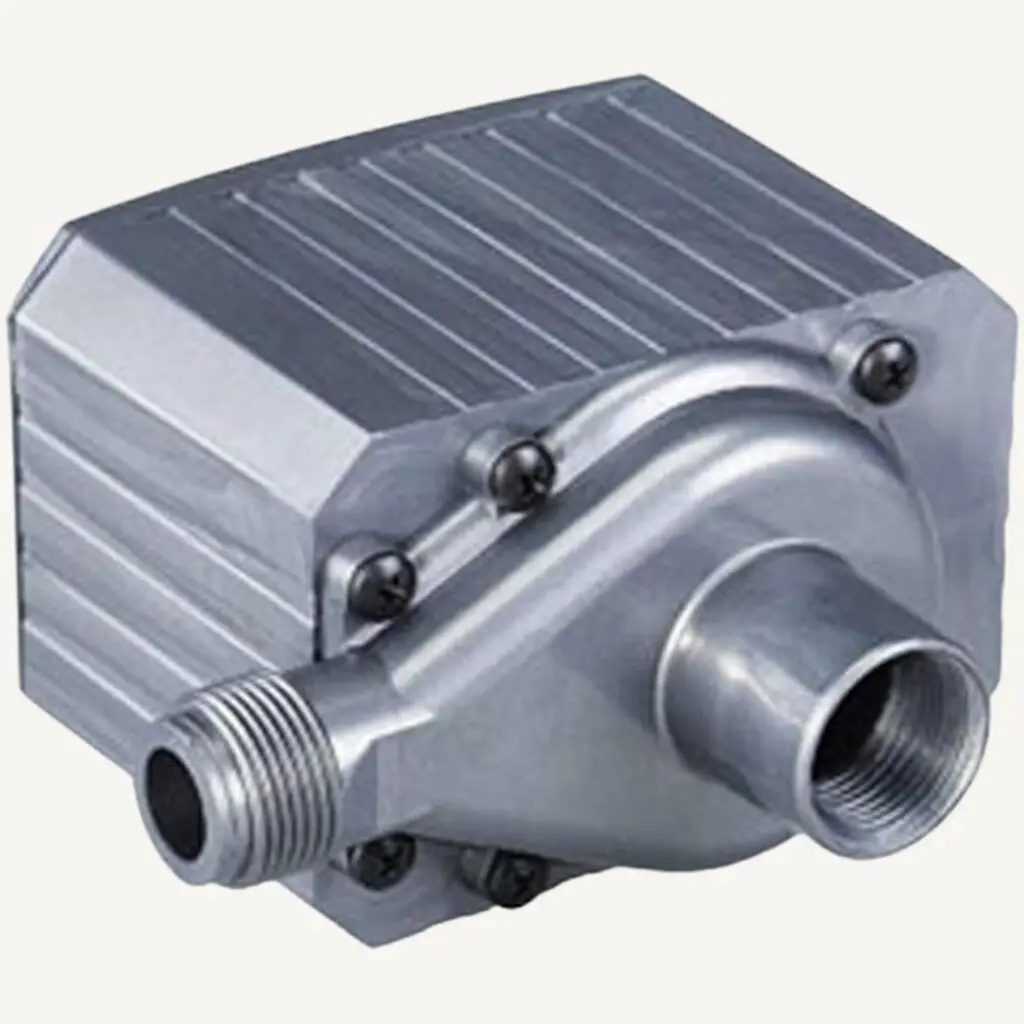
Danner Pondmaster Pond-Mag
(250–950 GPH, seven sizes)
~$50–125, Amazon
The pump pond professionals run around the clock, with a five-year warranty.
Sizes: match max head to 1.5× your rise — the small Mags carry statuary and bowls, the 9.5 carries tall tiered fountains.
Best Value
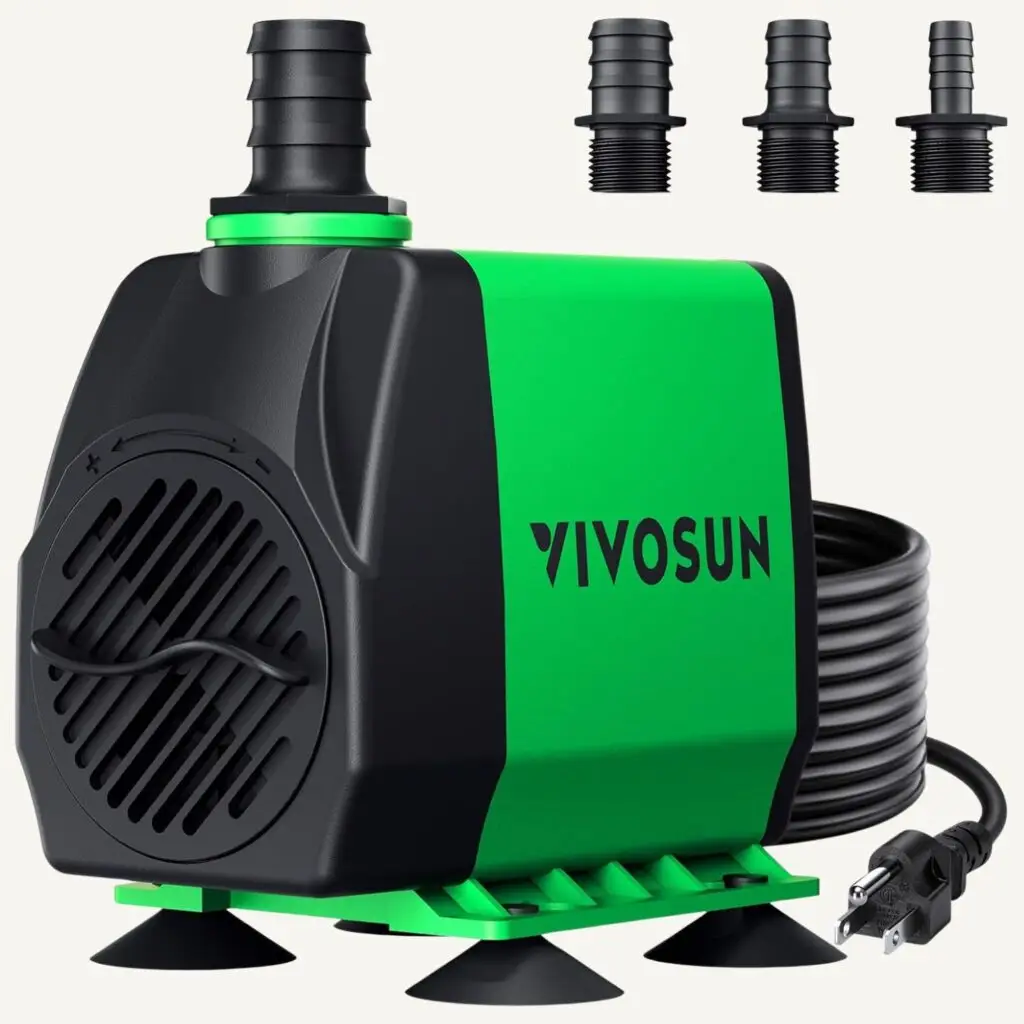
VIVOSUN
800 GPH
~$25, Amazon
The budget pick with one caveat: its cord is just 6.5 feet long.
If your outlet is close enough it’s a lot of pump for the money.
Best for Large Fountains
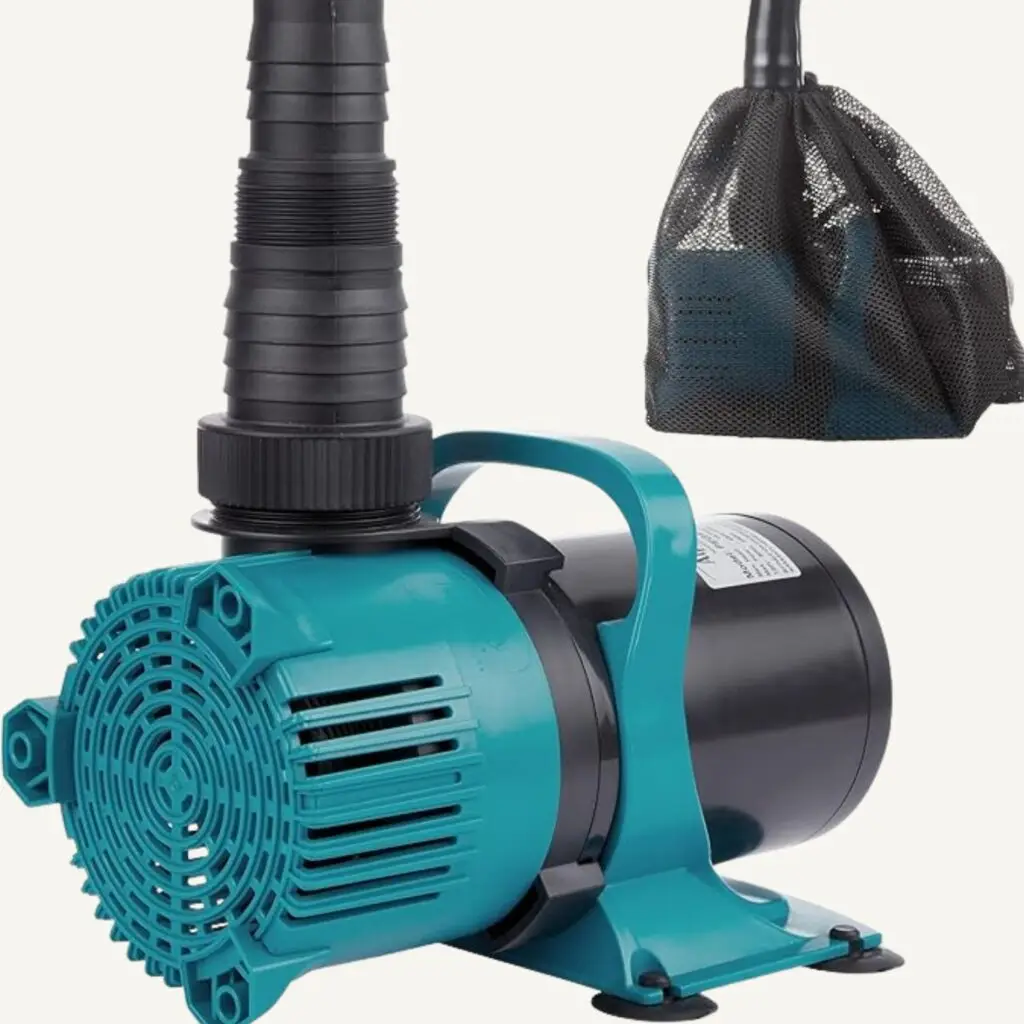
Alpine Corporation Vortex
(2,100–6,550 GPH, multiple sizes) ~$155–300, Amazon
Vortex impeller with a debris-handling mesh pre-filter bag, 20-foot cord
Sizes: the 2100 covers most residential waterfalls; the 4700 (shown) handles large tiered fountains and ponds.
Related: Cabinet Hardware Refresh: How to Beautifully Update Without Replacing
What Separates a Five-Year Pump from a One-Season Pump
- The Guts: Mag drive over direct drive. Magnetic-drive pumps run quieter, draw less power, have no oil to leak into your basin, and routinely log five to seven years of continuous duty. This is the single biggest durability lever you control.
- The Reach: cord length is the silent dealbreaker. The cord has to reach a GFCI outlet without an extension cord — extension cords strain the motor and outdoor code is not on your side. Budget pumps ship with 6-foot cords. For a garden fountain, 16 feet is the floor. Measure your run before you fall in love with a pump.
- The Screen: a real pre-filter for your real situation. Clogged intakes kill more pumps than age does. A pre-filter cage means a monthly rinse instead of a dead pump in August.
- The Confidence: a warranty will tell you what the manufacturer already knows. Danner backs their mag-drive pumps for five years. Aquascape, three. The $20 pumps, one year or none. Price the life of the product into your decision.
What NOT to do When Buying a Fountain Pump
Don’t size the pump by how the fountain looks.
Size it by vertical rise and spout diameter. “It seemed big enough” is how you end up with a trickle.
Don’t buy a no-name pump.
If you need reliability. My five-year survivor was cheap, but it was a real brand with real specs and a parts ecosystem. Buyer beware with a $12 pump that might give out mid-season and vanish before the warranty claim.
Don’t cut the plug to fish the cord through conduit.
It voids the warranty, and buried splices are a code violation waiting for an inspector — or standing water.
Don’t run any pump dry, ever.
One dry afternoon does more damage than a year of full-time duty. Protection costs $40 (more below).
What I’m Buying for Rosemont: An “Unkillable” Fountain Pump System
Now for my situation, the fountain and the forest are conspiring to make fountain life more interesting.
My pump lives sealed under the heaaaavvvvyy cast base. The only access is through 6-inch arched cutouts between the supports, and getting anything out means draining the whole fountain.
My realistic service window: once a year. And the garden is surrounded by forest, which means fall isn’t a leaf event — it’s leaf-a-palooza.
So the question stopped being “which pump is best” and became “what system survives neglect.”
My fountain pump solution is made up of five parts, each one closing a failure mode:
- Aquascape Ultra 1100 (~$130) — small enough to slide out under the arches, 12-foot max head for my 7-foot rise, and oversized on purpose. Throttled down to a gentle cascade, it loafs instead of straining, and a partially loaded intake cage can’t touch the flow. 25-foot cord, three-year warranty. Clogging and wear: closed.
- Little Giant RS-5 piggyback float switch (~$40) — cuts power if the water level drops. I will never see a low basin under that metal, so the switch watches it for me. Pump burnout: closed.
- Hudson automatic fill valve (~$30-$90) — a self-contained float valve fed by a garden hose that tops the basin off as evaporation lowers it. Five years of hand-filling ends here. Evaporation: closed.
- Outdoor smart plug (~$25) — when the forest starts dumping, the fountain takes leaf season off with a tap on my phone. A stopped pump doesn’t pull leaves onto its own intake; they float harmlessly until I scoop the basin once after the trees finish. Leaf siege: closed.
- The service kit — fresh tubing, stainless clamps, and a quick-disconnect union at the pump outlet, with the pump mounted on a thin sled and a pull loop laid toward the arch. Next year’s winterizing checklist: reach in, unclip, pull the loop, rinse the pump, submerge it in the basement for winter. Bring it back in the spring. The fountain never moves. The annual teardown: tamed.
Total: about $240 -$300. Not dirt cheap. But not a deal-breaker.
Every dollar buys the same thing — a fountain that runs beautifully without me.
The Spring Clean (and the Plot Twist)

This was supposed to be the post payoff.
You know, where I show you the full teardown — old pump out, new pump in, the works.
BUT….the weather and the fountain had other plans: the fountain basin is currently holding a (welcome) spring influx of rainwater, and there are three mysteries down there I’m still working through — a power cord that disappears under the brick apron, a mystery float contraption of unknown purpose, and a finish that needs more help than a hose-down.
So that payoff is relegated to part 2.
The shop vac and I have an appointment to unfill the fountain. And get her glowing again.
The full process post — teardown, the cord situation, the float autopsy, and bringing the finish back — lands once the new pump is up and running.
Related: How to Renovate Your Bathroom Without Eroding its Soul
FAQ
What size fountain pump do I need for a 3- or 4-tier fountain?
Measure the vertical rise from the water surface to the top outlet, then buy a pump whose max head is at least 1.5 times that number. For a 7-foot fountain, that means an 11-foot max head minimum. Then check the flow chart for GPH at your actual height — about 100 GPH per inch of spout diameter gives a gentle cascade.
How long do fountain pumps last?
A quality mag-drive pump runs five to seven years of continuous duty, and the best-warrantied models are backed for five. Cheap direct-drive pumps often fail within one or two seasons, especially if they ever run dry.
Can I leave my fountain pump running all the time?
Yes — mag-drive pumps are designed for continuous operation, and constant flow is better for the pump than frequent stop-start cycles. The non-negotiable: the intake has to stay fully submerged. Pair your pump with a float switch or auto-fill valve so evaporation can’t leave it running dry.
How do I keep my fountain pump from running dry?
Two ways, and they stack: a piggyback float switch (~$40) cuts power when the water drops, and an automatic fill valve (~$30-$90) connected to a garden hose tops the basin off so the level never drops in the first place.
Shop This Story
Some links may be affiliate links, meaning I may earn a small commission at no additional cost to you.
- Aquascape Ultra 1100 — the heart of the system (what we’re using at Rosemont)
- Danner Pondmaster Pond-Mag 9.5, 950 GPH — the reliability pick for pumps you can actually reach, 5-year warranty
- VIVOSUN 800 GPH — best value, short cord caveat
- Alpine Corporation Vortex 4700 — big fountains and waterfalls, debris-handling mesh bag, 20-foot cord
- Little Giant RS-5 float switch — the $40 pump life insurance (in the Rosemont system)
- Hudson automatic fill valve — never hand-top your fountain again (in the Rosemont system)
- Outdoor smart plug — the leaf-season off switch (in the Rosemont system)
- Fountain water clarifier — keeps the water clear between cleanings; the bottle that makes “once a year” believable. Safe for birds and animals, NOT FISH SAFE. (what we use at Rosemont)
- Pool skimmer net — the post-leaf-season scoop, and the two-minute save all summer
- Tubing, stainless clamps + quick-disconnect union — the service kit nobody remembers until the basin is drained