

This Post Is For You If…
- You’ve always wanted to shop an auction but never understood how it works.
- You won something once and the final bill surprised you.
- You want old-house-worthy furniture, decor, and lighting, and don’t want to be limited to what’s in stores.
Some links may be affiliate links, meaning I may earn a small commission if you choose to purchase, at no additional cost to you. I only share products I like, would use in my own home, or have researched and feel confident recommending.
I’ve been buying at auction for a long time, both in person and online. In fact, my house is filled with auction finds I’ve wrangled from near and far, acquired over the last 15 years or so. For most pieces, I remember the thrill of bidding, the hassle of shipping, and the joy of placing my winning in its new spot of honor.
Auctions are a fun, powerful way to fill an old house with vintage furniture and art: a mix of patina and modern that’s collected, not bought. Here’s how I shop, bid, and ship for Rosemont.
Auction vs. Retail: Where the Real Deals Are
On LiveAuctioneers alone, I’ve been winning auctions since 2016. Over the years, that’s expanded to EBTH, auction houses direct and local estate auctions. Coveted furniture, glassware, decor, art, and finds I just couldn’t go without, like a complete year of Interiors magazine from 1965 to add to my design library. I’ve won lots for less than $100, and spent thousands.
When I consider what my own wins would be valued at today, one thing is clear: buying at auctions can really pay off.
- George Nelson catenary chairs. A pair with ottomans sold at Wright in 2022 for $8,750. Mine cost a fraction of that. Find catenary chairs at auction →
- A nine-foot sideboard. The widest credenza at CB2 at the time I’m writing this is 96 inches and $2,799 on sale. Mine is 110 inches, sixty years old, rosewood and mahogany, and cost $2,183 delivered, patina and all. Find sideboards at auction →
- A large lot of Roseville Pottery “Raymor” Dinner and Serveware (in stunning condition). Price results (and what’s in the lot) vary, but I somehow got the whole lot to my door for under $250. A perfect gift for my son and his wife, who were just kitting out their new home. Find Roseville Pottery “Raymor” at auction →
Art is different. Most art by lesser-known artists resells for less than you’d hope, which is why I only buy art I love. Living with what brings you joy is a return on the investment.
Related: Sourcing Stunning Art for Your Old Home (at every price point)
Prices on retail sites like 1stDibs and Chairish show the dealer asking price, not what pieces actually sell for. For a real number, research past auction results for the same maker or design.

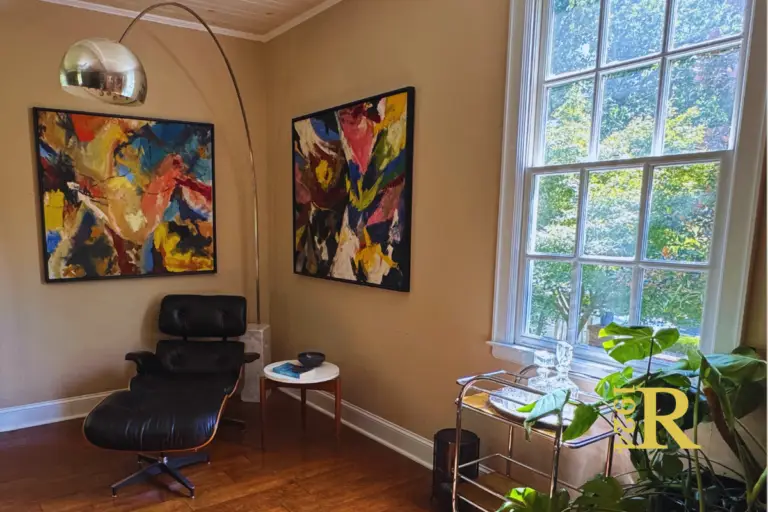
Won at auction, now in my office.
I Call It An InCHAIRitance
Because good vintage and historic design has real value.
For example, the catenary chair (pictured above) is designer George Nelson at his most American: designed for Herman Miller in the early 1960s, it’s very hard to find today, and engineered so the seat floats on a cage of chrome rods. It was a chair I had on my hunt list for years.
Set in a Colonial Revival house, about as classically American as architecture gets, spanning time and aesthetic. Modern and classic don’t fight.
The chair looks like it was always meant to be here. And will be just as valuable (or more so) when I’m done with it.
Do you need a place to wrangle your vintage wishlist?
I made The Hunt List, an easy-to-use tracker so you can do just that!
Get The Hunt List
My free auction and antique tracker.
Track what you’re hunting for, what fits, and what it will really cost.
You’ll also receive Letters from Rosemont: old-house projects, antique treasure hunts, trusted sources, and lessons learned, straight to your inbox.
Auction 101: How It Works and the Terms to Know
Online auctions bring the auction room to your laptop. There are really two types of online auctions, and they work very differently.
| Type | How it works | Where you’ll see it |
|---|---|---|
Timed online auction | Lots open for days and close at a set time. The highest bid at the close wins. | EBTH, HiBid, eBay, and many local estate auctions |
Live (simulcast) auction | What you see in movies. A real auction, streamed. An auctioneer calls the lots in order, and you bid online against people in the room and on the phone, in real time. | Most sales on LiveAuctioneers and Invaluable, plus well-known and regional auction houses |
How an Online Auction Works, Start to Finish
Before the Sale
- Create an account, either with the auction house or the platform, then register for any sale you want to bid in. Most houses require a card on file, and approval can take a day or two, so do this step early.
- Preview the catalog. Lots post days or weeks before the sale. The photos, estimate, and description are all you get, so if you need more, ask for a condition report and more photos.
- Pro-tip: If an auction you’re interested in is close by and holding an in-person preview, go.
Bidding
- Name your price. Set a max bid (also called an absentee or proxy bid), and the platform bids for you, one increment at a time, only as high as it needs to. If your max is $500 and the other bidding tops out at $200, you’re the winning bid at the next increment (say, $210 or $225, not $500).
- Or bid live and choose the increment yourself.
- Watch the close. A lot of timed auctions have a soft close: a bid in the final minutes adds time to the clock, so last-second sniping rarely works. Live lots close when the auctioneer drops the hammer. It can happen fast, sometimes in just a minute or two.
After You Win
- Pay and pick up quickly. The invoice arrives after the sale: the hammer price plus fees (more on those below). Some platforms may charge your card on file automatically.
- Arrange shipping or arrange to pick it up yourself. Local estate auctions often give you a short pickup window, sometimes a day or two. Miss it, and you can lose the item.
- Pro-tip: ALWAYS review the shipping details in the auction listing and call if you have questions ahead of the auction.
Auction Terminology: Money Terms
| Term | What it means |
|---|---|
Hammer price (winning bid) | The winning bid when the auction closes. It’s where the cost starts, not where it ends. |
Buyer’s premium | The auction house’s fee, a percentage added to the hammer price. Vintage and antique art, decor, and furnishings generally run between 15% to 30%. |
Sales tax | In most states, charged on the hammer price plus the premium, so you pay tax on the fee, too. |
Processing fee | Some houses add about 3% when you pay by card. It may not show up until the invoice. |
Shipping | A separate quote from a third-party shipper. Many auction houses don’t offer packing or shipping. |
Auction fever | The rush that makes you bid past your limit because you’re winning, or the competition is hot, not because the piece is worth it. The priciest term on this list. |
Auction Terminology: Catalog Terms
| Term | What it means |
|---|---|
Estimate | The auction house’s guess at what a lot will sell for, shown as a low and high range. An educated guess, not a promise. |
Reserve | The confidential minimum a seller will accept. If bidding doesn’t reach it, the lot doesn’t sell. |
Passed / bought in | A lot that didn’t meet the reserve price or didn’t sell. These are the ones to ask about after the sale. |
Condition report | The house’s written description of damage, repairs, and wear. If a listing doesn’t have one, ask. |
As is | Auction items are sold in their current state, with all their faults & flaws. No returns, so make sure you’re clear on the condition of the piece before bidding. |
Provenance | The documented history of the lineage of ownership. Strong provenance adds value and trust. |
Attributed to | The house believes it’s by a particular maker or artist but can’t prove it. “By” is a stronger claim. |
Period vs. style | “Period” means made in that era. “Style” means made later to look like it. A “Chippendale style” chair is a reproduction. |
Married | A piece assembled from parts of two different pieces, like a top and base that didn’t start life together. |
Bid Price Is Just the Beginning: What to Know About Auction Fees
I won a 110″ wide rosewood and ribbon mahogany mid-century sideboard with a $1,300 hammer price (winning bid). By the time I got it home, I’d paid $2,183.45. Here’s where the other $883 came from.
| My sideboard, c. 1960 | What I paid |
|---|---|
Winning bid | $1,300.00 |
Buyer’s premium (30%) | $390.00 |
Sales tax (6.75%, on bid + premium) | $114.08 |
Card processing fee (3%) | $54.37 |
Shipping (uShip) | $325.00 |
My “All-In” total cost | $2,183.45 (+68% over Hammer) |
And it’s not a perfect piece. The veneer has flaws, and the doors need attention. I knew that when I was bidding.
I bought it for the size: it fits perfectly between two plaster columns in our living room. I’d have a hard time walking into any store and finding nine feet of mid-century storage that I’d love in my 1924 house for that price. I’ve happily lived with it ever since, blemishes and all.
Across my auction wins, fees have added 23% to 43% to my hammer price before shipping.
But some of that (I’ve learned over time) is avoidable cost.
How to Pay a Lower Buyer’s Premium
Use the platform (like LiveAuctioneers) to find it. Bid direct with the auction house to win it.
The platforms are brilliant for searching hundreds of auction houses at once, but convenience can come with a cost. For example, at Concept Art Gallery, the same lot carries a 20% premium if you register directly and pay by check or wire, 24% on a credit card, and 27% if you bid through LiveAuctioneers. On a $1,000 winning bid, that’s $70 back in your pocket before tax.
- Search across auction houses on the platform. Find the item(s) you’re interested in, then note the auction house’s name.
- Read that house’s terms of sale on their website directly. Look for “buyer’s premium” and whether it changes by bidding method, amount, or payment type.
- Register directly with the house. Days ahead, because approval isn’t instant.
- Bid direct: on their own site, as an absentee bid, or by phone.
- Pay the cheapest way they offer, usually check or wire.
Not every house discounts direct bidding. Checking takes two worthwhile minutes.
Vintage vs. Antique: What’s the Difference?
These terms get used loosely, so here’s how I use them. Antique means at least 100 years old, the same line US Customs draws. Vintage means old enough to have a story but not yet 100, roughly 20 years and up. Most of my furniture wins are vintage mid-century pieces from the late 1940s through the 1960s. At Rosemont, as in any century home, anything as old as the house is officially antique.
Step One: How to Shop Online Auctions
Where to Find Auctions Worth Watching
This is not a complete list of all auction houses, but just by knowing these sources, you’re covering a ton of auction ground, and over time, you’ll develop your own preferences for platforms and auction practices across houses.
I started with LiveAuctioneers because I was able to see feedback from other buyers, and consolidate my search terms and alerts.
- LiveAuctioneers: hundreds of auction houses in one search. Most of my wins came from here.
- Invaluable and Bidsquare: more auction houses, often higher-end.
- AuctionZip: find local auction houses near you, where you can preview in person and pick up yourself.
- EBTH: online estate sales, bids from $1. Check pickup versus shipping before you bid.
Set Alerts for What You Love
Save your searches for the designers, makers, and artists you love, and let the alerts do the hunting. That’s how I built a collection of five Rochelle Blumenfeld paintings, all from the same Pittsburgh auction house, over five years.
Read the Listing Like a Dealer
- Read the condition report. If there isn’t one, ask for it.
- Pay attention to terms: “In the manner of” or “attributed to” don’t carry the same value as a piece with labels and provenance.
- Ask for more photos: the back, the underside, the joints, the signature.
- Know what “as is” means. What you see is what you get, with no returns.
- Measure your house first. Old houses have narrow doorways and tight, turning stairs. Measure before you bid on the sideboard.
How to Know What It’s Worth
An auction estimate is the house’s educated guess, not a price tag. Before I bid, I look up what the same piece actually sold for.
- Search sold results, not listings. LiveAuctioneers and Invaluable show past results for many lots. A dealer’s asking price is a wish. A hammer price is a fact.
- Research at the top of the market. Sotheby’s & Christie’s publish their past results, so you can see what the best examples sell for, then judge your find against them.
- Find the maker. Labels, stamps, and signatures change everything. A shell chair with its Herman Miller label is worth real money. The same chair without one is a guess.
- Weigh condition and originality. Refinished, re-covered, or missing parts pull value down. An original finish with honest wear usually holds it.
- Add the fees before you compare. A $1,300 bid that becomes $2,183 delivered has to beat retail or antique store prices to make sense.
Step Two: How to Bid at Online Auctions (Without Overpaying)
Set your all-in ceiling. Winning bid, plus buyer’s premium, plus tax, plus shipping. Decide that number before the auction starts, and stop when you hit it.
Register direct when it’s cheaper. The same lot can carry a lower premium off the platform. Here’s how to pay a lower buyer’s premium.
Leave a max bid, then walk away. Live bidding is fun, and fun is expensive. A max bid does the work for you, and it doesn’t get caught up in the moment.
Ask about lots you love that didn’t sell. When a piece passes with no bids, the auction house may take an offer after the sale. It never hurts to ask.
Patience is the real strategy. My best steal was the George Nelson catenary chairs. They were on my bucket list for years. When I look back at price results, my winning bid is the best I can find on record for a pair.
Step Three: How to Ship Auction Items Home
Auction houses and galleries rarely pack and ship for you. But most have go-to, trusted local shippers they recommend. Email or call them all, share the link to your piece, and ask EXACTLY how they will pack it: box or crate, foam corners, what happens to the glass. Ask what insurance covers and what it costs. Compare notes, and make a list of your go-tos that work. That list pays off every time you buy.
- Read the shipping terms before you bid, not after you win. Some houses are pickup only. Some have very tight or defined, “by-appointment” pickup windows.
- Get the quote before you bid. Shipping a large piece can cost more than the piece itself.
- Be concerned about breakables. For breakable lots, a call to the auction house can help home in on the “rightest” shipper.
- Furniture needs a freight plan. Ask about blanket-wrapped delivery, confirm how they’ll protect your piece from the elements and other items in the shipment. Or plan a road trip and pick it up yourself.
Real talk: Most of my deliveries have gone perfectly. The hard ones have been large, crated art, and early on, breakable items that … got broken on their way to me.
Once, a semi truck showed up to deliver a crated painting and couldn’t reach my house due to local road weight limits. I rented a small truck, met the driver in a not-too-distant Walmart parking lot, moved the crate from his truck to mine, and did the last mile myself.
It’s a lesson I won’t need to learn again.
What to Ask Any Shipper Before You Hire Them

- What type of vehicle will make the delivery? Can it reach my house, with road weight limits, a narrow drive, and room to turn? Is the trailer completely enclosed?
- Crate or blanket wrap? And how will the glass be handled?
- Curbside or inside delivery? Will you carry it in?
- What does insurance cover? At what declared value, and who files the claim?
- Will you photograph it at pickup? Condition photos settle disputes. If not, the auction house very likely will.
- How will we communicate while the item is in your care?
- How is payment handled? Before or after successful delivery?
- Do you have experience with this type of shipment? Uship is an online transport marketplace I’ve used for years. See customer reviews, get quotes, handle payments, all while keeping your personal data private.
What Not to Do When Buying at Auction
Don’t bid without doing the all-in math.
Auction fees alone added 43% to my sideboard, before shipping. Know your “not to exceed” number before the auction starts, and keep the auction fever at bay.
Don’t skip the condition report.
“As is” means you own an unexpected problem. Condition reports let you fall in realistic love.
Don’t forget the stairs. Or the muscle.
That sideboard has to get up the front steps and through 100-year-old doorways. Measure, plan, and make sure you have your plan before your winning comes home.
Don’t lose your mind.
There will always be another auction. I’ve lost a lot of glass auctions, and I’m fine with that. Glass and ceramics are hard and expensive to ship. I’ve won them, used a reputable shipper, and still had pieces arrive broken. When you buy antiques, that can feel like failing as a steward. So on anything fragile, my ceiling is firm, and auction fever doesn’t stand a chance. Know your ceiling and whether it’s firm or flexible before bidding starts.
Related: 6 ‘Sneaky Modern’ Old House Upgrades: Don’t Ruin the Patina
Old house rule: your house is one of a kind. What you bring into it should be, too.