
This post is for you if…
- You have art or shelves you love but they’re not getting their “moment”
- You want your library, office, or living room to feel layered and warm, not overhead-lit and flat
- You’ve been looking at picture lights and can’t figure out what actually works vs. what just looks fine in a photo
- You’re working with plaster walls or need plug-in or rechargeable options
Hate the story but want the exact sources?
→ shop the entire story
Some links may be affiliate links, meaning I may earn a small commission if you choose to purchase — at no additional cost to you. I only share products I genuinely like, would use in my own home, or have researched and feel confident recommending.
The Picture Light is the Hardest Working Light in the House
There’s a specific quality of light in a room I want to live in — warm, layered, directional in places, ambient in others, and never [EVER. EVER!] coming only from the ceiling.
In the rooms that make me feel … like I’m LIVING RIGHT … whether its a room in a home or a good hotel, there’s almost always a picture light shining, a lamp doing something useful in a corner, and a sconce or two that are more decorative – more about the feeling – than functional. The story they all tell together makes a room feel cohesive.
My take?
The picture light is the toughest component to solve for in that equation.
A lamp you can move; a sconce you can wire. But a picture light makes you commit — to a piece of art, to a wall or shelf location, and in my house, to a mounting solution that doesn’t destroy plaster or require a call to the electrician.
I have a few pieces of art with picture lighting at Rosemont. The Situ art lights I use are spendy, so I need to be sure of the placement and the art itself before I commit.
Adding library lights to our living room built in shelves is on my (loooong) project list. Getting those in will finish the lighting in that room, acting as the final layer to an already layered lighting story.
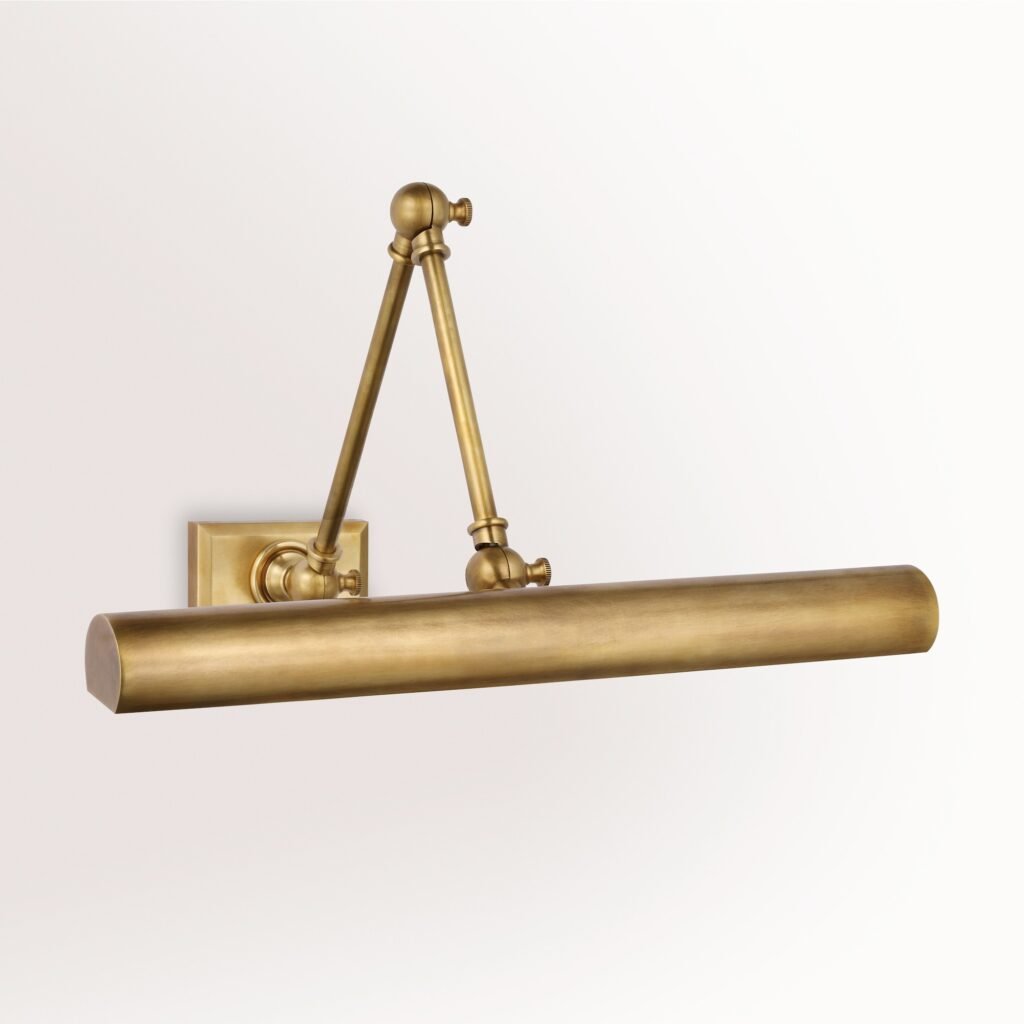
I’ve got my eye on the Visual Comfort Cabinet Maker Double Library Light so I can angle the light more directly onto the shelving. That’s a project I’ll need to do when we prioritize the electrician’s next big project, rewiring the first floor.
Why lighting decisions are different in an old house
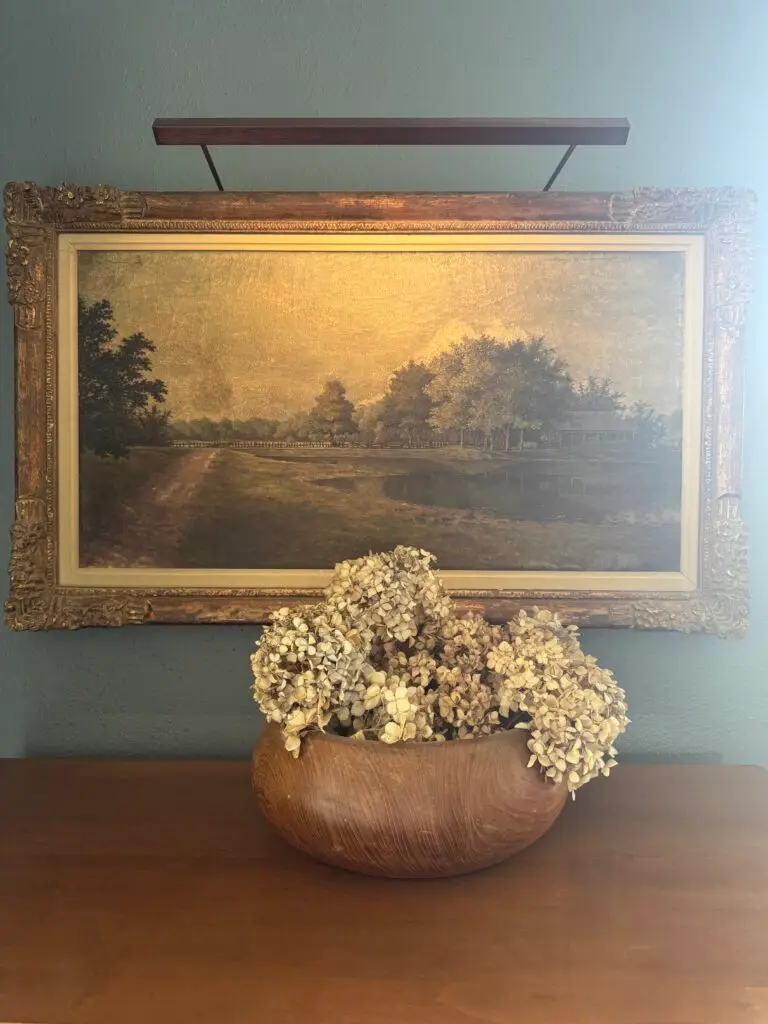
My hydrangeas are doing the hard work of hiding the cord.
New construction gives you the option to wire everything in a way that makes sense. I have no idea what that experience is like, but I imagine it’s pretty terrific. And maybe boring?
But in an older house with original plaster walls and lath behind them, adding wiring to a new location is a project, not a simple “let’s do it!” decision.
There’s also the unexpected craziness of wiring that’s “grown up” over the last 50 to 80 years. Old wiring that connects seemingly unrelated rooms, new wiring that’s tied into old wiring.
It’s a puzzle that comes with every old house
Unless you open up the whole house and rewire completely. In our house, it’s a project that gets tackled over time.
But fear not! Plug-in and rechargeable picture lights exist for exactly this reason. Not all of them are worth using — the cord management on plug-in lights can create an “ugly wire” problem, and rechargeable lights vary widely in battery life, light quality, and color temperature.
The other old-house-specific issue: scale.
Picture lights designed for contemporary minimal spaces often look too small and too slight next to art hung in a room with 9-foot ceilings and substantial molding.
A light that would be perfectly sized in a modern apartment can disappear entirely in a period room.
What makes a picture light feel right vs. wrong
Right: warm brass or aged metal finish, solid arm construction (not plastic disguised as metal), beam that’s wide enough to light the full painting rather than a hot spot, color temperature at or below 3000K.
Wrong: cool white LEDs or stark florecents, polished chrome or brushed nickel finish in a warmly lit, warm toned room, plastic construction that reads as temporary, and any light that outshines the art or shelving it’s supposed to be highlighting.
Jump to picture light sources
Task and table lamps give us a place to gather
A good table lamp in the right spot is the difference between a room that works after dark and one you abandon for somewhere brighter. The lamp doesn’t have to be precious — it just has to be in the right place, at the right height, with a shade that diffuses rather than directs.
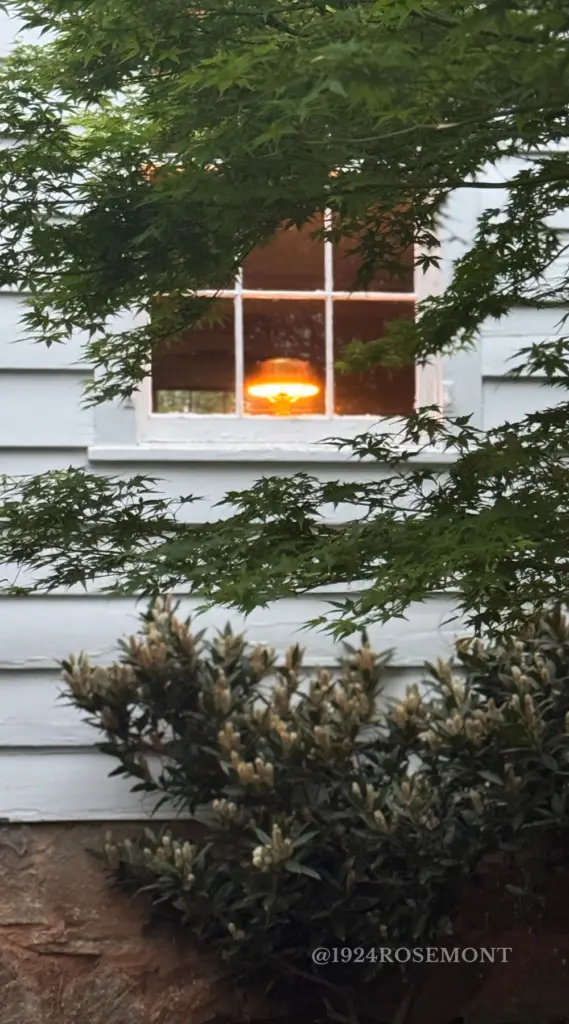
In an older house, look for bases with some weight and history to them — ceramic, turned wood, aged brass. A linen or cotton shade in a warm white. I’m a huge fan of lights in front of windows, so my home at night gives off a golden glow inside and out.
Jump to task and table lamp sources
Sconces are the pure drama we invite into our house
A sconce in a library, office, or living room isn’t doing the same job as a sconce in a bathroom. You’re not lighting a task. You’re adding drama — something that makes the room feel lived in when the overhead is off (OR DIMMED! AS IT SHOULD BE!) and the picture light is doing its work.
The ones that are most at home in an older house: swing-arm sconces on a visible arm (not floating), plug-in where wiring isn’t practical, warm brass or aged bronze, with a shade that throws light where you want the eye to flow.
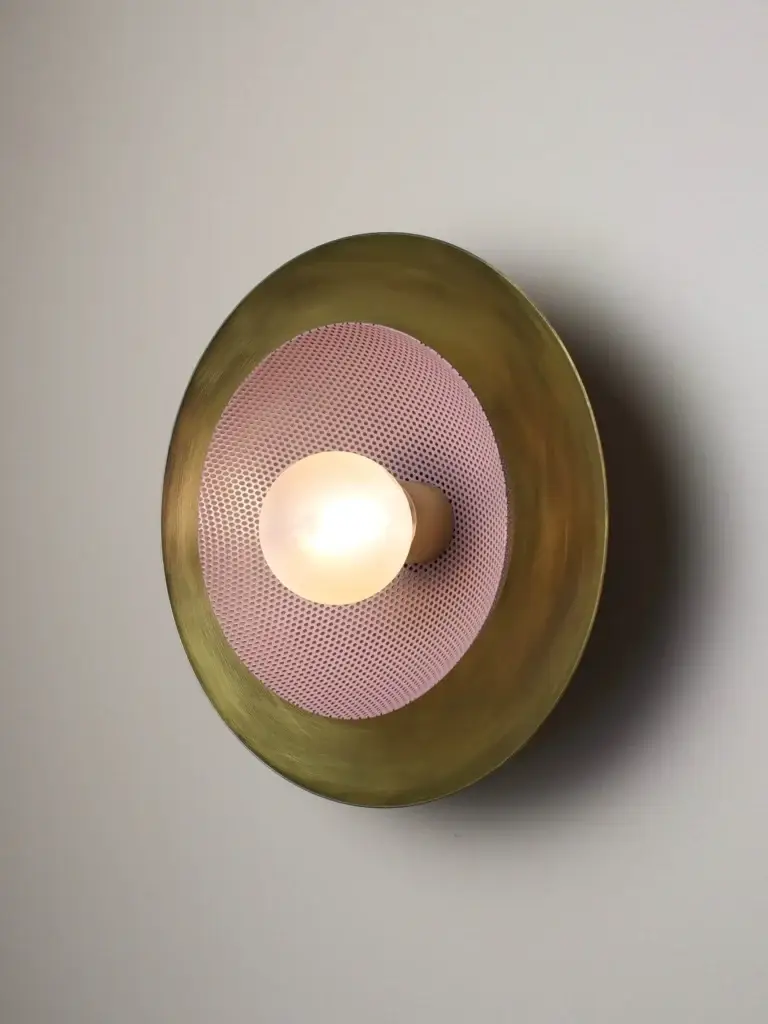
Our living room sconces bring a modern moment to the room, and are handmade by Blueprint lighting (similar style here).
Jump to sconce sources
Old House Rules
Whether your library is a library (and, if it is…CONGRATULATIONS!) or an office or living room. Even a hallway.
Some practical guidance you can use:
- Size to the art, not the wall. A picture light should span roughly 50–75% of the painting’s width. Most stock sizes run 12″, 18″, 24″ — match accordingly.
- Color temperature matters more here than anywhere. A 4000K picture light on a warm oil painting is a real problem. Stay at 2700K–3000K (I wrote more on lighting temperature here).
- Rechargeable lighting has gotten genuinely good. The best rechargeable lights now run 8–12 hours on a charge and are indistinguishable from hardwired at normal viewing distance.
- Cord covers exist and work. For plug-in lights, paintable cord covers eliminate most of the visual problem.
- And don’t hold back on table lamps and sconces that create a vibe. A small lamp on a table in the evening giving off a just-right glow is an invitation to use that space.
- Facebook Marketplace and vintage markets are rich with cool old lights. Rewiring kits are inexpensive and available on Amazon (and other sources)
- Don’t like the finish on an inexpensive lamp or sconce? That’s why they make Rub n’ Buff, spray paint, and gold leaf! I have so many “altered” finishes in my house. It’s another EASY DIY way to spend less and get the look you want.
Shop this story
Some links may be affiliate links, meaning I may earn a small commission.
- Picture lights both high and low
- Cabinet Maker Double Library Light, $$$ this one’s on my project list to light the built ins when we finish the living room rewire
- Situ Lighting Remote Controlled LED Art and Picture Light, $$$ I love these lights for LED and tuneable light for my art
- [Situ look for less] Dimmable LED Picture Light, 2700K/3000K/4000K, $ here’s a look for less that I’d hit with Rub N’ Buff to give it some age
- Situ Lighting Cordless and Rechargeable LED Micro Series, $$$ High quality and rechargeable for when you can’t plug in
- [Rechargeable for less] Picture Lights with 3 Color Temps, $ These have multiple temperature options to make the light perfect for the room they’re in
- Task and table lamps we love
- Henley Task Lamp, Visual Comfort Signature, $$$ is short, stout, and has a heavy glass diffuser that makes the prettiest light. This is the light shining in the living room window (above)
- Verner Panton Flowerpot Lamp, VP9 Red Beige, 1968, $$$ is one of those lamps that give a great cozy glow and looks amazing lit or not
- [Verner Flowerpot look for less] Flowerpot Lamp-esque, dimmable, $$ a look-for-less version you can take with you
- Sconces that bring the drama
- Blueprint Lighting Centric Mesh, $$$ handmade in NYC and New Jersey, this one’s similar to the now-discontinued sconces in our 1924 living room
- Modern Forms Blaze 24in LED Wall Sconce 3000K in Gold Leaf, $$$ has a similar look to the Blueprint sconce, is still spendy but gives beautiful glow
- Raw Brass Wall Sconce/Dome Light, $$ This one would be incredible in multiples lighting a hallway, is rated for commercial use, and gives a handmade look for less
- Alabaster Wall Sconce, $$ I love that alabaster looks warm and soft both when it’s lit and when it’s not
- Other ways to up your lighting game
- Rub n Buff Wax Metallic Finish Golds Three Pack Like everything but the finish? Change it!
- Lamp Making Kit for DIY Rewire Table and Floor Lamps Found a lamp you LOVE on Facebook Marketplace but the cord is iffy? REWIRE IT!
- Cord Covers for Wires on Wall These are paintable and have 41,000 reviews with a 4.5 average rating.